Category: Uncategorized

  • Apple Card’s New Chapter with Chase

    Apple Card’s New Chapter with Chase

    Apple has confirmed that Chase will become the new issuer of Apple Card, replacing Goldman Sachs over a transition period of roughly 24 months. The announcement closes one chapter in Apple’s financial services journey and opens a more conventional one.

    Apple Card launched in 2019 with a clear ambition. A credit card designed around transparency, simplicity, and tight integration with the iPhone. That positioning resonated strongly with users. What changes now is not the product experience, but the banking partner operating behind the scenes.


    Why Goldman Sachs is stepping back

    Goldman Sachs entered consumer banking with high expectations, and Apple Card was its most visible move. Over time, the economics proved harder than anticipated. Credit cards require scale, long-term investment, and a tolerance for relatively thin margins.

    Goldman has since narrowed its consumer focus and shifted attention back to areas where it has deeper expertise and stronger returns. Exiting the Apple Card program fits that recalibration. It reflects a strategic realignment rather than a rejection of the product itself.


    Why Chase is stepping in

    For Chase, Apple Card represents a very different opportunity. Chase already operates one of the largest and most mature credit card businesses globally. It brings underwriting experience, servicing scale, regulatory infrastructure, and balance sheet strength.

    By taking over as issuer, Chase gains exposure to a highly engaged, premium customer base without needing to build the user experience layer. Apple continues to control design, onboarding, and day-to-day interaction. Chase focuses on what it already does well.


    What changes for users and what does not

    From a customer perspective, continuity is the central message. Apple has stated that users can continue using Apple Card as normal throughout the transition. There is no requirement to reapply.

    Core features remain intact. Daily Cash rewards, Family sharing, Monthly Installments, and in-app account management stay in place. The payment network also remains unchanged. The issuer transition is intentionally designed to be low-friction and largely invisible to users.


    The bigger fintech lesson

    This move highlights a familiar dynamic in fintech. Technology companies excel at experience, distribution, and engagement. Banks excel at regulation, credit risk, and operating at scale.

    Apple Card works because Apple does not try to be a bank. The new setup works because the bank does not try to be a consumer tech company. Clear separation of roles tends to produce more resilient partnerships over time.

    Key takeaways for fintech startups

    There are a few practical lessons worth pulling out.

    • Strong user experience can survive changes in underlying infrastructure

    • Consumer credit rewards scale and operational maturity

    • Partnerships evolve as strategic priorities change

    • Stability matters more than novelty during transitions

    • Clear role ownership reduces long-term friction

    If you are building or scaling a fintech product and need support with strategy, positioning, or partner decisions, Your Fintech Story works with founders facing exactly these challenges. Reach out and let’s shape the next chapter together.


  • How PayPal and Microsoft Are Bringing Checkout Into AI Conversations

    How PayPal and Microsoft Are Bringing Checkout Into AI Conversations

    AI has been moving closer to commerce for a while, mostly through discovery and recommendations. With the launch of Copilot Checkout, another boundary shifts. In early January, PayPal announced it will power Microsoft’s new in-chat checkout experience inside Copilot. Users can now search, compare, and complete a purchase without leaving the AI interface.

    For fintech founders, this is more than a feature launch. It signals a structural change in how intent becomes a transaction.


    What Copilot Checkout Changes in Practice

    Copilot Checkout allows users to move from product discovery to payment in a single conversational flow. Instead of clicking through search results, landing pages, and carts, the entire journey happens inside Copilot. The AI acts as a shopping assistant, while the checkout itself is handled by PayPal’s commerce and payment infrastructure.

    PayPal brings familiar capabilities into this environment: card payments, guest checkout, branded merchant experiences, and buyer protections. Importantly, merchants still process the transaction and retain the customer relationship. The AI interface becomes the front door, not the merchant of record.

    That distinction matters. Earlier platform-led commerce models often blurred who owned the customer and the transaction. Here, the roles are more clearly separated. Microsoft provides the AI layer, PayPal provides the rails, and the merchant remains central to the sale.


    Why This Partnership Makes Strategic Sense

    For Microsoft, commerce fits naturally into Copilot’s role. If users already ask the AI what to buy, enabling them to complete the purchase reduces friction and increases engagement. For PayPal, the value sits earlier in the funnel. Payments are no longer limited to the final checkout step. They become part of the decision moment.

    This also aligns with PayPal’s broader push into agentic commerce, where AI systems can surface products and initiate transactions with minimal user effort. Copilot Checkout becomes a visible, consumer-facing expression of that strategy.


    What This Signals for the Fintech Ecosystem

    The bigger story is not Copilot itself, but the model behind it. Discovery, decision, and payment are converging into a single interface. Payment providers that integrate cleanly into AI environments gain relevance much earlier in the customer journey.

    At the same time, merchants will continue to demand clarity around data ownership, brand visibility, and compliance. AI-driven checkout does not remove regulatory responsibility. If anything, it concentrates it.

    For fintechs working on payments, onboarding, fraud, or merchant tooling, this is a directional signal. AI is becoming a primary interface for commerce, and infrastructure players are racing to embed themselves at that layer.

    Key takeaways for fintech startups

    A few lessons stand out from the Copilot Checkout launch:

    • AI interfaces are evolving into full transaction environments

    • Payment infrastructure is moving closer to the moment of intent

    • Merchants still expect ownership of customers, data, and brand experience

    • High-quality product and pricing data becomes critical in AI-driven commerce

    • Trust, compliance, and reliability remain table stakes

    If you are reassessing where your fintech product fits as AI reshapes commerce flows, now is a sensible moment to do it deliberately.

    If you want help pressure-testing your positioning or translating market shifts into a clear strategy, Your Fintech Story works with fintech teams to turn change into focused, practical growth decisions.

  • Fiserv and Mastercard Expand Partnership Around Agentic Commerce

    Fiserv and Mastercard Expand Partnership Around Agentic Commerce

    In December 2025, Fiserv and Mastercard announced an expanded partnership focused on enabling what they describe as trusted agentic commerce for merchants. The collaboration builds on their long-standing relationship and targets a new phase of digital payments shaped by artificial intelligence and automation.

    The announcement reflects a broader industry shift. Software agents are increasingly capable of researching products, making selections, and completing purchases on behalf of consumers. For payments, this raises practical questions around security, authorization, and merchant control. The Fiserv and Mastercard initiative is positioned as an infrastructure response to those questions.


    What Agentic Commerce Looks Like in Practice

    Agentic commerce refers to transactions initiated by automated agents rather than humans clicking through checkout flows. These agents may operate within digital assistants, enterprise tools, or consumer-facing platforms. From a merchant perspective, the transaction still needs to meet familiar requirements: clear authorization, fraud protection, and reliable settlement.

    Fiserv and Mastercard are not introducing a new consumer-facing product. Instead, they are focusing on the acceptance layer. The goal is to allow merchants to safely accept payments initiated by trusted agents, while maintaining visibility and control over how those transactions occur.


    The Role of Mastercard’s Agent Pay Acceptance Framework

    At the center of the partnership is Mastercard’s Agent Pay Acceptance Framework. Fiserv plans to implement this framework across its merchant solutions, making it available at scale. The framework combines several established payment capabilities, including tokenization, authentication, and fraud controls, and adapts them for agent-initiated use cases.

    Tokenization is particularly important here. Rather than exposing card details during an automated transaction, a tokenized credential is used. This reduces risk and aligns agentic payments with existing card security standards. The integration also incorporates Mastercard’s Secure Card on File capabilities to support recurring and delegated payment scenarios.


    Merchant Control and Governance

    A recurring theme in the announcement is control. As automation increases, merchants risk losing visibility into who or what is initiating transactions. Fiserv has emphasized governance tools and insights as part of the solution, allowing merchants to define rules, monitor activity, and manage exceptions.

    From Mastercard’s perspective, the framework is designed to distinguish trusted agents from malicious automation. This is intended to help merchants benefit from efficiency gains without opening the door to new forms of fraud or abuse.


    Why This Matters for the Payments Ecosystem

    This partnership signals that large payment incumbents are preparing for agent-driven commerce as a structural change, not a fringe experiment. It also shows a preference for extending existing card and acceptance infrastructure rather than replacing it.


    Key takeaways for fintech startups

    Here are a few practical points worth noting:

    • Agentic commerce is being addressed at the infrastructure level, not as a standalone product.

    • Tokenization and authentication remain central, even when humans are not directly initiating payments.

    • Merchant control and governance are emerging as critical design requirements.

    • Large processors and networks are moving early to define standards in this space.

    If you are navigating how automation, AI, and payments intersect in your product or strategy, Your Fintech Story can help you assess what is relevant now and what can wait. Reach out if you want a grounded discussion tailored to your business.

  • Bunq Reapplies for a US Banking Licence

    Bunq Reapplies for a US Banking Licence

    Bunq, the Dutch challenger bank, has submitted a new application for a national US banking licence with the Office of the Comptroller of the Currency. This marks a return to the process after its earlier attempt in 2024 did not proceed to approval.

    The updated filing reflects Bunq’s continued commitment to entering the US market. It also reflects changes in the US regulatory environment, where authorities have shown more openness to challenger banks in recent years. Other fintech companies including PayPal, Nubank and Coinbase have also pursued US banking charters in this period.


    Why Bunq Is Trying Again

    Bunq’s first effort to secure a US banking charter was withdrawn in 2024. The company faced friction between Dutch regulators and US authorities which created uncertainty about whether the application would be successful. Rather than risk a prolonged process that could distract from other parts of the business, Bunq chose to step back.

    Since then, Bunq has taken a more gradual approach to US expansion. In 2025 the company received approval from the Financial Industry Regulatory Authority for a broker-dealer licence. That licence allows Bunq to offer investment services such as stocks and mutual funds in the US. It has allowed the company to start building a presence and a customer base without full banking operations.

    The new national banking licence application builds on those foundations. If approved, Bunq would be able to take customer deposits in the US and offer a broader range of retail banking products. Bunq’s proposal includes helping customers build US credit histories by using their European financial data to inform credit scoring. This is a clear attempt to address a common challenge faced by internationally mobile customers.


    What Bunq Is Targeting

    Bunq has more than 20 million users in Europe. The bank has built a reputation among tech-savvy and globally mobile customers such as expats, frequent travellers, and remote workers. The company sees the US as a natural next market for these users. It plans to focus initially on metropolitan areas with significant expatriate and internationally mobile populations.

    Bunq’s strategy suggests it plans to pursue a measured entry rather than compete directly with large US banks from the start. By focusing on a specific niche where existing solutions are weak, Bunq can demonstrate value quickly. Helping customers establish credit histories addresses a real pain point for many people who relocate to the US.


    Why This Matters for Fintech

    Bunq’s renewed bid is part of a wider trend of fintech firms engaging with US banking regulators. For startups considering global expansion, this trend offers useful insights. Securing a US banking licence is difficult. But recent activity shows that progress can be made with the right strategy and timing.

    Using intermediary licences to build local presence while pursuing more comprehensive permissions is one approach to consider. Listening to customer needs in the target market can help refine service offerings and prioritise features that matter most.


    Key takeaways for fintech startups

    • Regulatory environments change over time which can open new opportunities.

    • Building a presence with intermediate licences helps when pursuing larger licences.

    • Targeting specific user needs can make market entry more effective.

    • Cross-border expansion requires alignment with both home and host regulators.

    If you are planning to expand into new markets or navigate complex regulation, reach out to Your Fintech Story to explore practical strategies for growth.

  • Flutterwave acquires Mono to strengthen open banking capabilities across African markets

    Flutterwave acquires Mono to strengthen open banking capabilities across African markets

    Flutterwave has agreed to acquire open banking company Mono, bringing financial data connectivity and account to account capabilities into its broader payments platform. The acquisition reflects a shift toward deeper financial infrastructure in African markets, where bank transfers, mobile money, and regional payment rails often sit closer to everyday customer behavior than card networks.


    Why open banking matters for Flutterwave

    Flutterwave already operates across multiple African markets with payments, remittances, wallets, and merchant services. Many of its business customers work across borders, handle diverse customer segments, and need payment flows that match local habits. Adding open banking helps address this reality at the infrastructure level.

    With Mono’s technology, Flutterwave can access customer-permissioned bank data, verify account ownership, and support direct account to account transactions where appropriate. This can reduce friction during onboarding, improve fraud controls, and provide payment choices that align with how users prefer to transact in markets where card penetration is still developing.

    From a platform perspective, this creates a closer connection between payments, identity checks, and financial data. It supports use cases that rely on verified account activity rather than static documentation or manual checks.


    What Mono adds to the infrastructure

    Mono was founded in 2020 with a focus on connecting fintech companies and financial institutions to bank systems through APIs. Its services make it possible to review transaction history with user consent, confirm that an account belongs to the right customer, and enable data-driven assessments in lending and financial services.

    In many African markets, formal credit files remain limited for a large share of the population. Bank activity and transaction behavior therefore play a meaningful role in risk assessment, eligibility evaluation, and customer trust. Mono’s infrastructure has helped fill that gap by turning live financial data into an operational tool for fintech firms.

    Keeping Mono as a distinct business unit within the Flutterwave group allows its team to continue developing its core product while aligning with a larger payments ecosystem.


    How this shapes the ecosystem

    The acquisition shows how African fintech infrastructure is maturing toward more integrated platforms. Open banking is becoming part of the base layer that supports compliance, underwriting, onboarding, and payment innovation. When financial data, identity checks, and payment initiation operate inside one environment, it becomes easier for partners and developers to design services that reflect real customer behavior at scale.


    Key takeaways for fintech startups

    Here is a short summary of the main lessons from this acquisition:

    • Integrated platforms that combine payments and financial data can create stronger value for partners and developers.

    • Customer-permissioned bank data supports better verification, onboarding, and risk assessment where credit files are limited.

    • Account to account payment options remain strategically important in markets where bank transfers are widely used.

    • Maintaining product independence inside a larger group can protect innovation while benefiting from platform scale.

    • Infrastructure decisions increasingly shape how fintech products grow across multiple markets.

    If you are developing or scaling a fintech product and want support in shaping your strategy, positioning, or partnership approach, Your Fintech Story can help you build a roadmap grounded in real market dynamics.

  • Airwallex’s Netherlands Investment Signals a Confident European Expansion Strategy

    Airwallex’s Netherlands Investment Signals a Confident European Expansion Strategy

    Reuters reported that Tencent backed fintech company Airwallex plans to invest about €200 million in the Netherlands over the next five years, strengthening its presence in Europe and deepening its operational base in Amsterdam. The move shows how the company is shifting from a primarily Asia Pacific growth story toward a more balanced global footprint.

    For fintech founders, this decision is a useful case study in combining regulatory positioning, local presence, and international scale.


    Building a Stronger European Hub

    According to Reuters, the investment will support Airwallex’s Amsterdam operations and its broader European Economic Area activities. The company also plans to increase its local workforce by roughly 60 percent, bringing the Amsterdam team to around 70 full time employees by the end of 2026.

    The Netherlands is a practical choice for a European hub. Amsterdam is a financial and technology centre within the EEA, and a local team helps align operations with regulators while improving proximity to clients in multiple markets.

    Airwallex obtained a financial licence in the Netherlands in 2021, enabling it to provide services across the EEA. The upcoming investment builds on that foundation rather than treating Europe as a remote satellite market.


    From Rapid Growth to Global Presence

    Airwallex was founded in 2015 in Melbourne and has grown through a series of major funding rounds, including early backing from Tencent. Reuters reported that the company has passed $1 billion in annual recurring revenue and has been valued at more than $6 billion following recent investment activity.

    Its platform supports over 150,000 business customers who use its services for international payments, multi currency accounts, and cross border financial operations. Airwallex is increasingly positioning itself as an infrastructure partner for globally scaling digital businesses.

    Expanding in Europe also places the firm alongside established competitors such as Adyen, Mollie, and Bunq. These players have strong regional roots, while Airwallex brings a globally oriented infrastructure approach that appeals to companies operating across continents.


    Key takeaways for fintech startups

    Here are a few practical lessons fintech leaders can draw from Airwallex’s Netherlands strategy:

    • Local regulatory presence can be a growth asset rather than a constraint.

    • Hiring within strategic regions strengthens credibility with both clients and supervisors.

    • Global platforms scale more effectively when operations are supported by grounded regional teams.

    Airwallex’s investment illustrates how international expansion benefits from a clear regulatory base, a measured talent strategy, and a long term operational commitment rather than a purely commercial footprint.

    If you are planning to scale your fintech into new regions or strengthen your go to market approach in Europe, contact Your Fintech Story. We help founders shape expansion strategies, refine positioning, and grow with confidence.

  • Sumary Raises €4.2M Pre-Seed to Build AI-Native Finance Workflow Platform

    Sumary Raises €4.2M Pre-Seed to Build AI-Native Finance Workflow Platform

    Copenhagen-based fintech startup Sumary has raised €4.2 million in a pre-seed funding round to continue developing its AI-driven finance workflow engine. The round was led by byFounders, with participation from Partech, Tenity, and several angel investors including Morten Primdahl (co-founder of Zendesk) and Christian Rasmussen (founder of Roger). Rasmussen will also join Sumary’s board as chairman.

    The funding round is described as one of the largest pre-seed investments in Denmark, reflecting growing investor confidence in AI-native financial infrastructure products.


    Building an AI-Native “Finance Workflow Engine”

    Sumary is developing a platform designed to automate finance and accounting workflows at the ledger level using artificial intelligence. The product focuses on tasks such as transaction interpretation, reconciliation, anomaly detection, and routine bookkeeping entries.

    The company positions the product as a finance co-pilot that supports accounting and finance teams rather than replacing them. The platform can identify issues such as miscoded items or VAT inconsistencies and allows finance professionals to query financial data and receive structured responses.

    Sumary highlights that its system is built as an AI-native platform instead of layering AI on top of traditional accounting tools.


    Founding Team and Early Traction

    The company was founded in 2023 by Pascar Sivam (CEO), Lucas Rantzau, Frederik Skov Wacher, and Bastian Schneider. The founding team combines experience across finance, technology, and entrepreneurship.

    Sumary’s platform is currently available to a limited set of early access users, including accounting firms and finance teams across sectors such as e-commerce, logistics, retail, and professional services. The company is working with selected partners to refine workflows and validate real-world use cases.


    Focus Areas for the New Funding

    The newly raised capital will be used to expand the engineering and machine learning teams, strengthen product capabilities, and scale European market presence.

    A portion of the funding will support partnerships with accounting firms that act as design partners. Their operational feedback is being incorporated into ongoing product development and rollout planning.

    The company remains focused on measured product expansion rather than broad public release at this stage.


    Investor Perspective

    Investors backing Sumary point to inefficiencies in finance operations such as manual data handling, reconciliation work, and fragmented financial tooling. Interest in automation and AI-supported decision processes is growing across finance departments and service providers.

    Sumary’s approach reflects a broader move toward AI-native systems in financial operations, particularly in areas where structured workflows and repetitive processes dominate daily work.


    Key takeaways for fintech startups

    Here is a short summary of what this funding round signals for the fintech ecosystem.

    • Large pre-seed round signals strong investor appetite for operational AI tools in finance and accounting.

    • Sumary is pursuing an AI-native product design instead of adapting legacy architectures.

    • The investor group combines venture firms and experienced fintech operators.

    • Early collaboration with accounting firms highlights the value of co-developing with end users.

    • Workflow automation in finance remains a growing opportunity in European fintech.

    If you would like help shaping or communicating your own fintech story, Your Fintech Story supports startups with strategy, content, and market positioning. Contact us.

  • PrimaryBid trims workforce and repositions its business model

    PrimaryBid trims workforce and repositions its business model

    PrimaryBid has reduced its workforce by roughly 40 percent after reporting continued losses and facing a significant writedown from one of its major shareholders. The company’s headcount fell from around 152 to 91 employees, with most reductions affecting technology and head office roles. Although pre-tax losses narrowed slightly year on year, the firm still reported losses of about £18 million, which placed pressure on operating costs and headcount.

    This development sits within a broader pattern affecting capital-markets-focused fintech firms, where weaker issuance volumes and softer retail investor participation are challenging business models that scaled during more active market conditions.


    A sharp reduction in headcount

    The size of the workforce adjustment indicates more than a tactical cost reduction. When an organisation removes close to half of its staff, it usually signals a structural reset in priorities, governance, and operating focus.

    In PrimaryBid’s case, the leaner structure concentrates attention on delivery discipline and a narrower strategic scope. It also shifts the centre of gravity of the organisation toward institutional relationships, which become more central as the business moves further away from retail-driven activity.


    A pivot toward institutional SaaS

    Alongside the restructuring, PrimaryBid is repositioning its technology toward SaaS licensing for financial institutions. Rather than centring its proposition on consumer access to primary market deals, the company is aiming to provide infrastructure capabilities to banks, exchanges, and capital-markets platforms.

    This pivot changes how the business captures revenue. Enterprise SaaS involves longer sales cycles and integration work, but it can also provide steadier, more predictable income once commercial relationships are established. It requires different strengths as well, including account management, partner enablement, and careful coordination across regulated environments.


    Investor signals and valuation repricing

    The London Stock Exchange Group’s decision to write down the value of its minority stake in PrimaryBid illustrates how investors are reassessing exposure to market-cycle risk in this part of the fintech ecosystem. A writedown of that magnitude does not in itself diminish the relevance of the company’s technology, but it does reset expectations around growth timelines, profitability pathways, and scale ambitions.

    For other fintech founders in adjacent segments, the case highlights the importance of having credible alternative revenue paths when core demand is tied to issuance volumes or retail participation.


    Key takeaways for fintech startups

    Before drawing lessons from this case, it helps to understand how PrimaryBid’s restructuring connects to its strategic repositioning.

    • Workforce reductions of around 40 percent typically indicate a strategic reset rather than a short-term cost exercise.

    • Moving from retail activity to B2B SaaS can stabilise revenues, but it requires enterprise-grade sales capability and focus.

    • Investor writedowns shape perception, partnership discussions, and hiring confidence as much as financial reporting.

    • Capital-markets-linked fintechs benefit from contingency revenue models that can support operations through market cycles.

    If your fintech is preparing a pivot, reassessing its cost structure, or redefining its growth strategy, Your Fintech Story can help you analyse your options and build a pragmatic, sustainable roadmap for the next stage. Let us know if you’d like support shaping that transition.

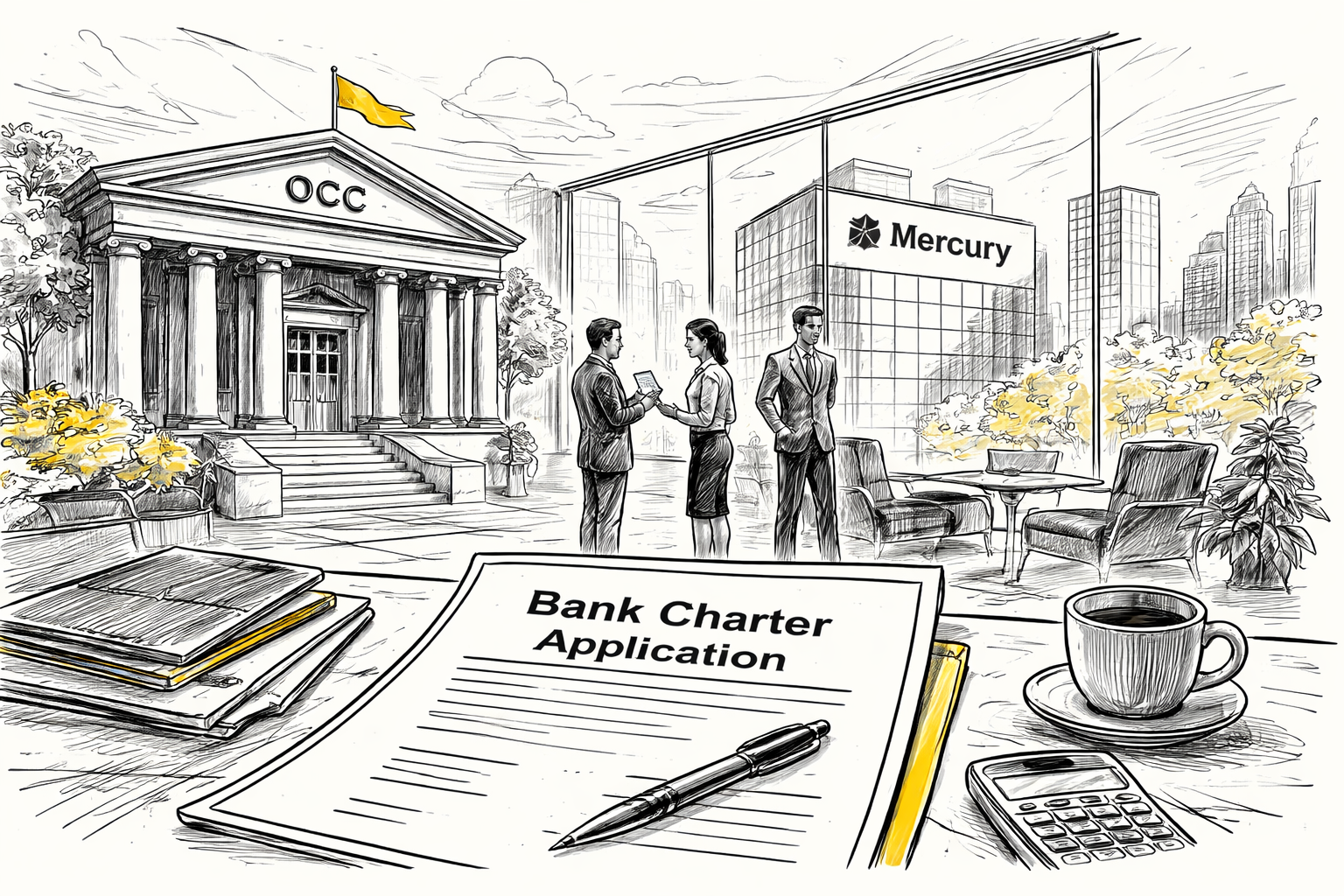
  • Mercury’s Bank Charter Move: What Filing With the OCC Really Signals

    Mercury’s Bank Charter Move: What Filing With the OCC Really Signals

    Mercury has formally applied for a U.S. national bank charter. In December 2025, the company submitted an application to the Office of the Comptroller of the Currency and, in parallel, applied to the Federal Deposit Insurance Corporation for federal deposit insurance.

    For a fintech that has grown by partnering with regulated banks, this is a structural shift. It does not change how Mercury works today, but it clearly signals how the company sees its future.


    From partner banks to direct regulation

    Until now, Mercury has operated through FDIC-insured partner banks. Customer deposits sit at those institutions, while Mercury focuses on product, software, and customer experience. This model is common across U.S. fintech, especially for companies that want to move fast without carrying full banking regulation from day one.

    A national bank charter would change that setup. If approved, Mercury would become a federally regulated bank, supervised directly by the OCC, and would hold deposits under its own FDIC insurance. That comes with significantly higher regulatory expectations, but also with more control over core banking activities.

    The company has been explicit that nothing changes for customers during the review process. Accounts, products, and access remain exactly as they are while regulators assess the application.


    Why now

    Mercury’s announcement provides context for the timing. The company reports serving more than 200,000 customers, generating around $650 million in annualized revenue, and being GAAP profitable for three consecutive years. It also states that roughly one in three U.S. startups uses its platform.

    Those numbers matter. Charter applications are evaluated not just on vision, but on operational maturity, financial stability, governance, and risk management. Filing at this stage suggests Mercury believes it can meet those expectations and sustain them under ongoing federal supervision.


    What a charter unlocks, and what it demands

    Operating as a national bank allows a company to offer deposit accounts directly, without relying on intermediary banks. That can simplify product architecture and open up longer-term strategic options. At the same time, it introduces continuous regulatory scrutiny, capital requirements, and compliance obligations that do not ease over time.

    This is not a cosmetic upgrade. It is a commitment to running a regulated financial institution, not just a software platform connected to one.


    Leadership and regulatory preparation

    Alongside the application, Mercury announced the appointment of Jon Auxier as Chief Banking Officer and proposed CEO and President of the future bank, subject to approval. His background includes senior roles at regulated financial institutions and experience with bank operations.

    That appointment reinforces the seriousness of the application. Regulators look closely at leadership depth and prior experience when evaluating new bank charters.


    A long road, not a guaranteed outcome

    Submitting an application starts a lengthy process. Approval is not automatic and can take many months. Regulators will review governance, compliance frameworks, financial resilience, and risk controls in detail.

    For now, the filing places Mercury in a small group of fintechs attempting to transition from bank partnerships to full bank status. It is a strategic bet on durability, trust, and long-term control.


    Key takeaways for fintech startups

    Here are the practical lessons worth noting:

    • Applying for a bank charter is a structural decision, not a branding move.

    • Strong financial performance and operational maturity matter before approaching regulators.

    • Partner bank models work well early, but they shape long-term constraints.

    • Leadership experience becomes critical once regulation is central to the business.

    • Regulatory timelines are long, and outcomes are never guaranteed.

    If you are weighing similar strategic paths, Your Fintech Story helps founders assess regulatory options, trade-offs, and timing. Get in touch.

  • Imprint’s path to a $1bn valuation

    Imprint’s path to a $1bn valuation

    Imprint reached unicorn status after closing a $150 million Series D funding round that valued the company at approximately $1.25 billion. The milestone mattered less because of the headline number and more because of the timing. The round came at a point when late-stage fintech funding was constrained and investor scrutiny had intensified. Imprint stood out by operating in a mature category and still convincing top-tier investors that meaningful growth remained.


    Rebuilding the co-branded card model

    Imprint was founded in 2020 with a clear premise: co-branded credit cards were structurally outdated. In the traditional setup, issuing banks controlled most aspects of the programme, while brands had limited influence over product design, rewards logic, or customer data.

    Imprint approached the market as infrastructure rather than a brand issuing cards directly to consumers. Its platform enables consumer brands to design and operate card programmes that feel like extensions of their own loyalty ecosystems. Imprint handles underwriting, compliance, servicing, and the operational complexity that brands prefer not to own.


    Why investors paid attention

    The Series D round was led by Khosla Ventures, with participation from Thrive Capital, Ribbit Capital, Kleiner Perkins, Hedosophia, Spice Capital, and Timeless. These investors are selective about late-stage fintech exposure, particularly in payments and lending.

    What made Imprint compelling was not novelty, but execution. The company demonstrated that co-branded cards, when paired with modern infrastructure and data-driven rewards, can still scale. Revenue visibility, repeat brand partnerships, and disciplined credit management helped support a valuation north of $1 billion.


    Brand partnerships as distribution

    Imprint’s growth model relies heavily on partnerships with established consumer brands. Publicly referenced partners include Rakuten, Booking.com, Crate & Barrel, and Fetch. Each partnership brings an existing customer base, reducing the need for expensive direct-to-consumer acquisition.

    For brands, the cards act as loyalty accelerators. For Imprint, they create predictable issuance volume and transaction activity. This alignment allows the platform to grow without chasing mass-market consumers or competing head-on with neobanks.


    Product expansion beyond credit

    The Series D funding was also positioned as fuel for expansion. Imprint has outlined plans to broaden its product set beyond unsecured credit cards into debit products, secured cards, and flexible financing options. Loyalty tooling and advertising capabilities are another focus area, reinforcing the idea that cards are engagement products, not standalone payment utilities.

    CEO Daragh Murphy has consistently framed the company’s direction around tighter integration between payments and the brands consumers already trust. That positioning aligns with broader embedded finance trends, while keeping Imprint focused on a clearly defined customer segment.


    Key takeaways for fintech startups

    Imprint’s journey highlights several lessons worth noting:

    • Mature fintech categories can still produce large outcomes when infrastructure is rebuilt thoughtfully.

    • Brand-led distribution can be more efficient than direct consumer acquisition in regulated products.

    • Late-stage investors prioritise clarity of revenue, risk management, and repeatable partnerships.

    • Product expansion works best when it deepens existing use cases rather than chasing adjacent hype.

    If you are building or scaling a fintech and want help sharpening your strategy, investor narrative, or growth priorities, Your Fintech Story supports founders and leadership teams with clear, experience-led guidance.

    Get in touch if you want to pressure-test your next phase before the market does it for you.