
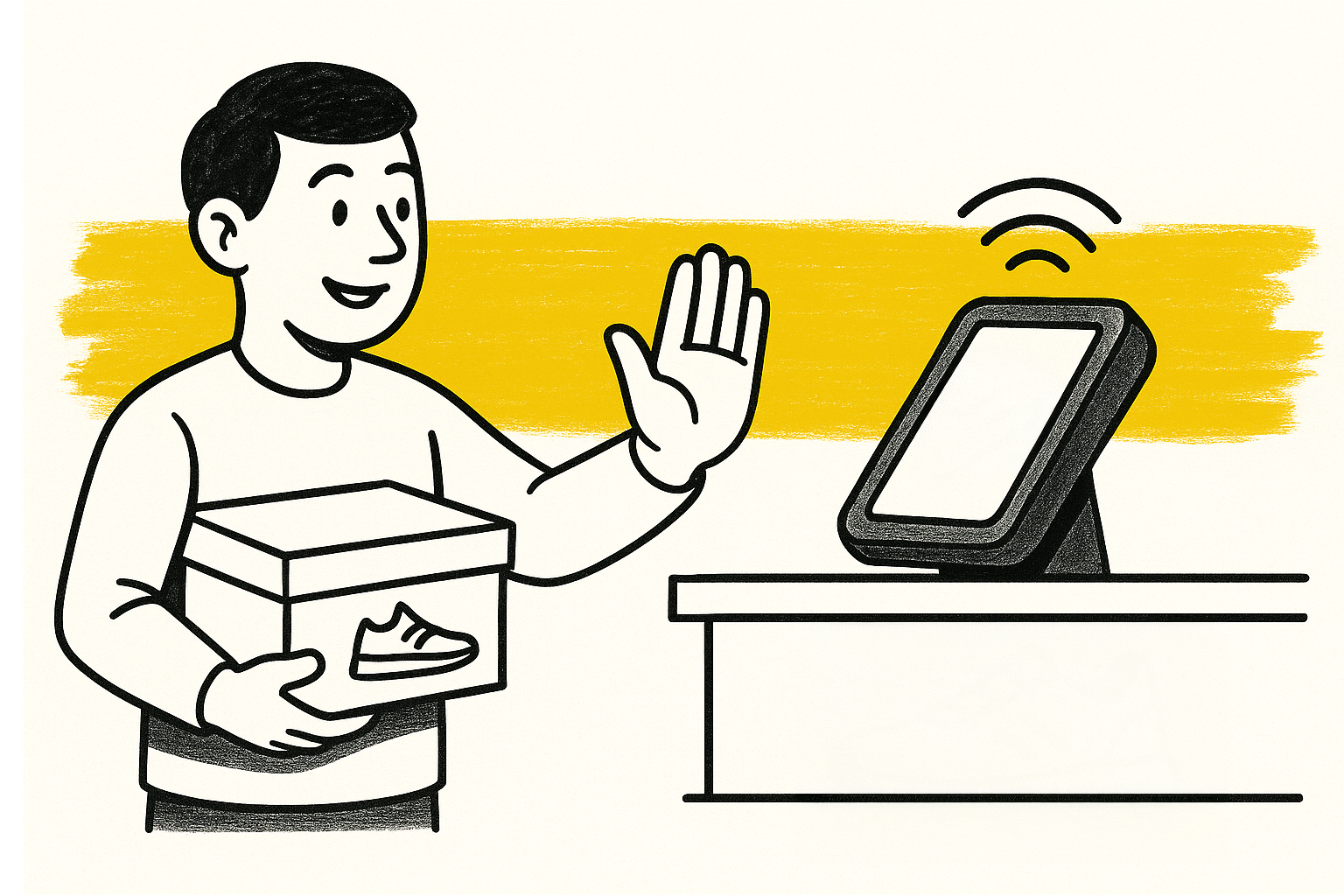

Paying with your hand isn’t science fiction. It’s showing up in stores, stadiums, and train stations around the world. The concept of using your hand as a payment method traces back decades. In the 1980s, a Kodak researcher named Joe Rice developed the first palm-scanning technology.
Early on, banks in Japan began using palm-vein scanners for secure ATM access. By 2015, palm vein authentication had quietly gained over 63 million users in 60 countries, mainly via banking and security applications.
One of the first big trials of paying by palm came in 2015 when Japan’s JCB partnered with Fujitsu to link palm vein IDs to credit cards. Startups had tried biometric payments before, but costs and low adoption slowed progress.
In 2020, Amazon introduced its Amazon One hand-scanning payment system, marking a new chapter where Big Tech brought biometric payments to everyday retail.
Palm Payments Today: Who’s Using Them?
Fast-forward to today, and paying with your palm is no longer just a tech demo. Amazon One leads in the West. First deployed in 2020, it uses palm print and vein pattern to verify identity. It rolled out to Whole Foods, and by mid-2023, was in all 500+ stores, after over 3 million uses. Customers link a credit card and hover their hand over a reader to pay. Amazon reports third-party uptake in places like Panera Bread and sports venues for age verification.
“We introduced Amazon One, a fast, convenient, and effortless way to enter, identify, and pay using your palm. Customers love this experience in our Whole Foods Market stores and hundreds of third-party locations.”
— Dilip Kumar, Vice President of AWS Applications, Amazon
In China, a palm payment boomlet is underway. In 2023, Tencent’s WeChat Pay launched a palm-scanning feature on Beijing’s Daxing Airport Express line. By fall, it reached over 1,500 7-Eleven stores in Guangdong. The system scans both palm surface and veins. It’s now used in gyms, campuses, restaurants, and more. Older adults in particular have embraced it as more intuitive than smartphones.
Alipay’s earlier facial recognition pay is still popular, though privacy concerns remain.
Mastercard began biometric checkout pilots in 2022, expanding to Latin America and Europe with palm and iris scans. In 2024, palm-vein payments launched in Uruguay. Other players include Poland’s PayEye (iris + face) and startups like Redrock Biometrics and Keyo.
Why Palm Payments Make Sense
Benefits of palm-pay include:
- Convenience: No cards or phones needed. Shoppers can simply use their hand to complete transactions. It’s fast, and you can’t forget or lose your palm.
- Contactless: No touch means more hygienic. This appeals especially in post-COVID contexts where cleanliness matters. Palm scanners read from a distance, reducing shared contact points.
- Security: Vein patterns are internal, hard to fake, and not left on surfaces. Unlike fingerprints or faces, palms are more protected from duplication. This makes them reliable for secure transactions.
- Privacy: You can’t scan someone’s palm without consent. The data is encrypted and opt-in. Palm images are converted to templates that aren’t easy to reverse-engineer.
- Inclusivity: Useful for elderly or people with limited mobility. A simple hand wave is easier than handling devices or remembering PINs. It’s an accessible way to participate in digital payments.
Compared to facial recognition, palm scans are opt-in and private. Unlike faces or fingerprints, palm vein patterns can’t be seen or lifted easily. False match rates are extremely low, and the pattern stays stable over time.
The Challenges: Privacy, Policy and Practicality
Adoption is still limited due to:
- Trust issues: Users fear biometric misuse. Handing over a body part, even digitally, feels high stakes. Providers need to clearly explain how data is used and protected.
- Regulation: GDPR and BIPA require explicit consent and security safeguards. Palm data is considered sensitive and subject to strict rules. Companies must ensure compliance from the start.
- Hardware cost: Terminals aren’t cheap. For small merchants, buying and maintaining scanners can feel like a big upfront investment. ROI isn’t obvious without widespread adoption.
- Behavioral change: Enrolling and using palm-pay isn’t yet habitual. People are used to cards or phones. Creating new habits takes effort and incentives.
- Competition: Cards, phones, and other biometrics (face, iris) are entrenched. Palm must prove it’s not just novel, but better. That means faster, safer, or more useful in key scenarios.
Fintechs must prove palm-pay is safer, easier, and worth the switch. Early user education and incentives can help.
What’s Next for Palm Payments?
Palm-pay’s future lies in integration, expansion, and inclusion. It’s likely to grow in retail environments, especially where loyalty programs and payments can merge into a single seamless scan.
The same palm used for checkout can also unlock stadium gates, verify age for alcohol purchases, or act as a transit pass – transforming it into a universal ID.
And for financial inclusion, palm-pay offers a new channel to reach people without smartphones or bank accounts, especially in emerging markets. The key will be partnerships; with retailers, banks, and governments, to ensure the infrastructure and trust are there.
Palm-pay may not replace your credit card anytime soon, but in high-friction, high-volume environments, it’s carving out a real niche.
Key takeaways for fintech startups
What can we learn from this?
- Solve real problems: Palm-pay shines where it removes friction. It’s not about novelty, but removing steps. Use it where convenience and speed matter.
- Privacy first: Make consent and security visible and simple. Users should know exactly how their data is handled. Compliance should be a feature, not a burden.
- Design for everyone: Elderly and underserved users are early adopters. Make the experience accessible from day one. Biometric UX should be intuitive.
- Plan for rollout pain: Hardware needs scale and support. Merchants won’t install scanners without a business case. Partnering with POS providers helps.
- Don’t oversell: Find a real use case. Not everything needs to be biometric. Focus on where palm-pay is clearly better.
Need help growing your fintech startup? Get in touch with us.


