
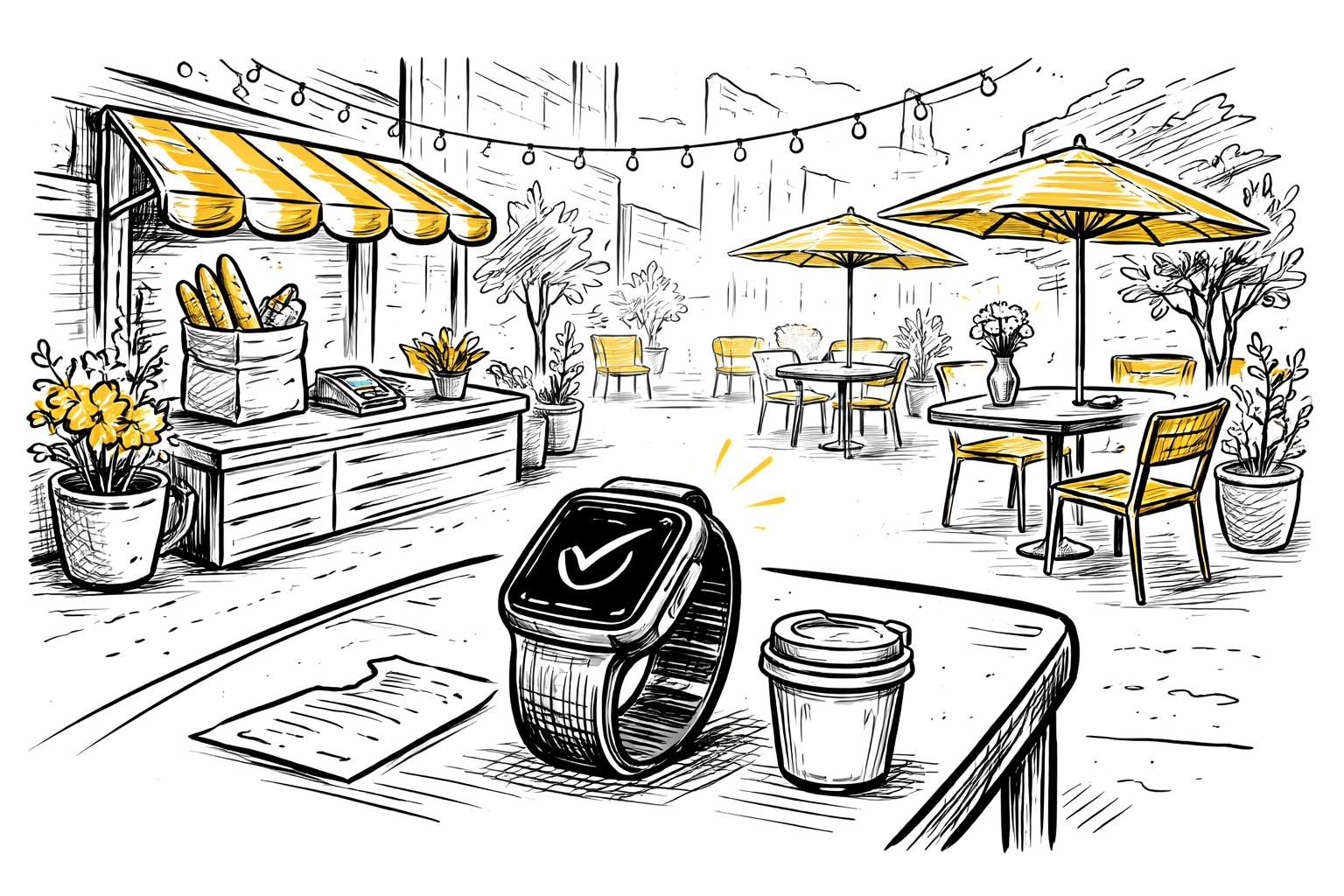

Huawei and YowPay just pushed POS hardware into a new form factor. A smartwatch. They launched what they describe as the first open banking smartwatch POS application, allowing merchants to accept payments directly from a watch using account-to-account rails. No terminal. No phone. Just a smartwatch on your wrist.
What actually changed
At a technical level, this is not about contactless cards or digital wallets. The solution is built on open banking and SEPA instant payments, using YowPay’s A2A orchestration layer. Payments move directly from one bank account to another, without card schemes in the middle, and settlement can happen almost instantly.
What stands out is that the merchant effectively becomes the device. Instead of carrying a terminal or relying on a phone, a small merchant can initiate and accept payments straight from a smartwatch. That is a meaningful shift in how payment acceptance is packaged and delivered.
Why this matters more than it looks
At first glance, this can feel like a hardware experiment. A watch is smaller, but that alone is not the story. The real shift is where POS lives and how it fits into everyday interactions.
POS has gradually moved from fixed terminals to mobile devices and then to software-based solutions on smartphones. A smartwatch pushes that evolution further. It removes another layer of friction. For certain use cases like street vendors, delivery drivers, or event staff, the payment flow becomes faster and more natural. There is less setup, less visible “process,” and more continuity in the interaction.
That change in behavior is often more important than technical improvements in speed or cost.
The open banking angle is the real story
The hardware gets attention, but the rails underneath matter more. This approach relies entirely on account-to-account payments enabled by open banking. That changes the economics and the structure of the transaction.
Without card networks in the middle, the flow becomes simpler. Costs can be lower, and fintech providers have more room to shape the experience. For years, A2A payments have been discussed as an alternative, but adoption in everyday merchant scenarios has been limited.
If a smartwatch can support this type of payment flow in a real-world setting, it suggests the infrastructure is becoming more usable. That is a stronger signal than the device itself.
What to watch next
This is not about replacing traditional terminals in the short term. There are clear limitations, including screen size, user experience constraints, and the need for user trust.
What it does introduce is a new category of ultra-light POS. The device becomes almost invisible, and the payment experience becomes more embedded in the interaction between merchant and customer.
The next phase depends on whether A2A payments continue to improve from a usability perspective, whether merchants trust these flows, and whether customers understand and accept them. If those pieces come together, the form factor becomes less important.
Key takeaways for fintech startups
A few grounded observations from this move:
- POS is becoming more flexible and less dependent on dedicated hardware
- A2A payments are starting to show real-world usability in merchant scenarios
- Merchant experience is gaining importance alongside consumer experience
- Hardware innovation only works when the underlying payment rails are ready
- Reducing friction in the payment moment remains the core competitive factor
If you are building in payments or fintech infrastructure, this is the kind of shift worth tracking closely.
Reach out if you want help turning signals like this into a clear strategy.


