Category: Uncategorized

  • AI Agents in Payments: Mastercard’s Agent Pay vs Visa’s Intelligent Commerce

    AI Agents in Payments: Mastercard’s Agent Pay vs Visa’s Intelligent Commerce

    In May 2025, both Mastercard and Visa unveiled AI-driven shopping assistants, marking a new era of “agentic commerce.” Each network’s solution lets digital assistants research, recommend and pay for consumer purchases — without manual input. These services promise to let busy consumers delegate shopping tasks to trusted AI, but they take different approaches to security, control and integration.

    This article focuses on the newest AI tools released by Visa and Mastercard related to agentic commerce, but we’ll cover other AI tools from these companies in one of the future articles.


    Mastercard’s Agent Pay

    Mastercard’s program, Agent Pay, is designed for conversational AI platforms. It uses what Mastercard calls “agentic tokens” to secure payments on behalf of users. These are merchant-specific, tightly scoped tokens — an evolution of Mastercard’s tokenization system — allowing AI agents to transact safely without exposing real card credentials.
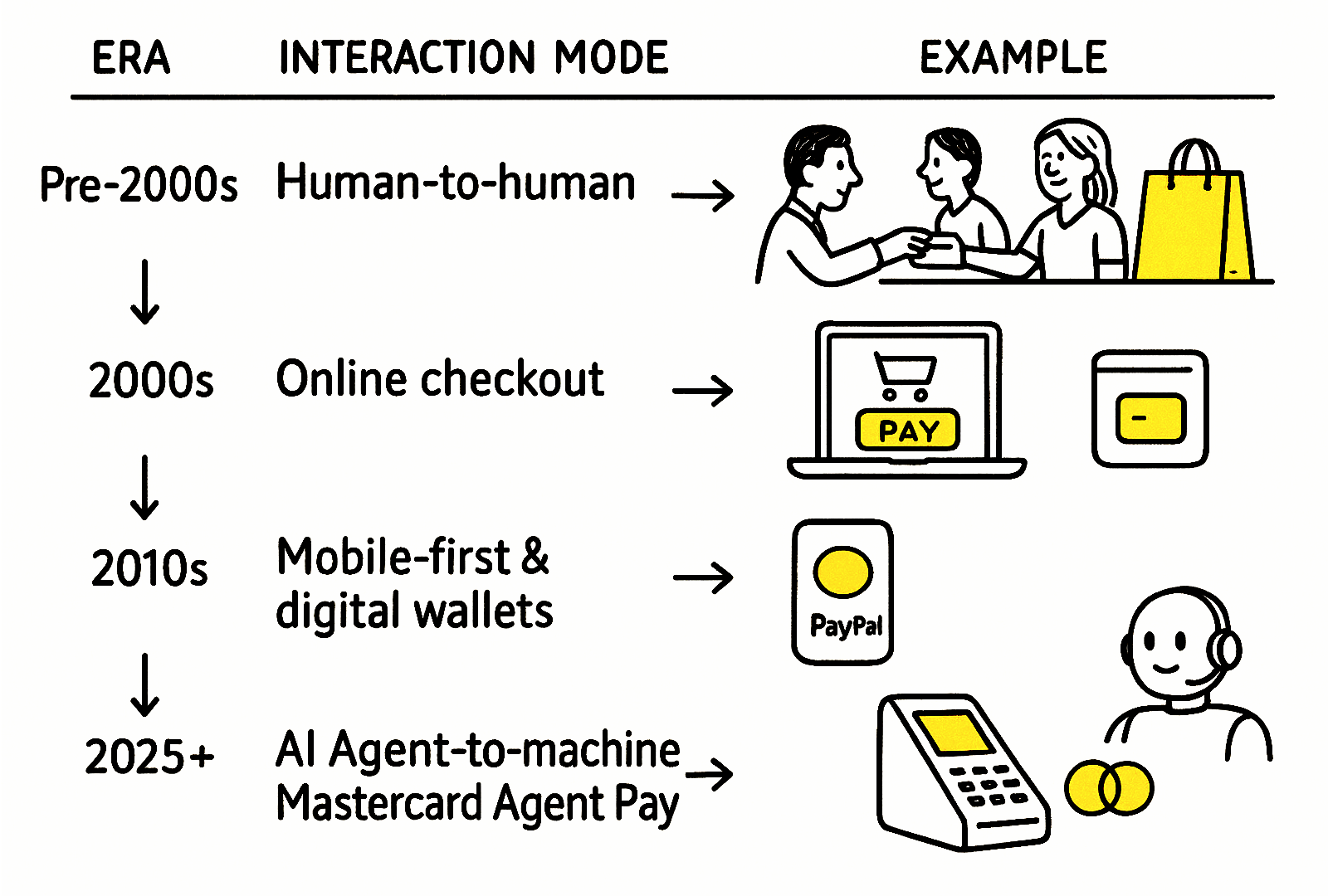

    Payment interactions evolved from face-to-face to AI-powered automation.


    Security is foundational to Agent Pay. Agents must be verified, transactions are traceable, and users can set granular permissions around what the AI can and can’t do. Mastercard also layers on biometric authentication, fraud monitoring, and dispute resolution. The platform is meant to be embedded directly into chatbots and voice assistants like Copilot or ChatGPT, enabling a seamless flow from recommendation to purchase.

    “With the introduction of Mastercard Agent Pay, we’re effectively letting consumers and businesses close the loop. The user can receive recommendations, have tasks completed and make purchases — all in one place.”

    – Sherri Haymond, Co-President of Global Partnerships at Mastercard


    Visa’s Intelligent Commerce

    Visa’s solution, Intelligent Commerce, is built for developers who want to plug AI platforms into Visa’s network. It introduces “AI-ready cards” — tokenized credentials that allow agents to act on behalf of a user without ever seeing the actual card number. These tokens are governed by real-time purchase limits and permissions defined by the user.

    Visa’s architecture is more API-driven, designed to integrate broadly with the AI ecosystem. Partnerships with OpenAI, Microsoft, Anthropic, and Samsung suggest a strong push toward embedding payment capabilities into consumer and enterprise AI tools. Like Mastercard, Visa emphasizes user control and data protection, with a delegated authorization model ensuring AI agents act within strict parameters.


    Two Different Visions for AI-Powered Payments

    Although both Mastercard and Visa launched AI agent capabilities within days of each other, they’re not building the same thing. In fact, they reflect two distinct visions for how AI will interact with the payments ecosystem.

    Mastercard’s Agent Pay is about building a seamless experience for end users who rely on AI assistants in their daily lives. It’s designed to fit naturally into conversational tools like Copilot or ChatGPT, enabling those assistants to go from recommendation to purchase — all under strict user-defined rules and secured by a robust tokenization layer. Think of it as giving your digital assistant a wallet and clear instructions on how to use it.

    Visa’s Intelligent Commerce, on the other hand, is aimed squarely at the builders — developers and AI platforms that want to embed payment capabilities into their applications. It’s an infrastructure play, offering APIs and “AI-ready” credentials that authorized agents can use to make purchases within defined parameters. Rather than focusing on a specific user interface, Visa is providing the rails for AI-enabled commerce across a broad range of contexts.

    So while both companies are enabling AI to transact, their approaches serve different use cases. One is tightly integrated into consumer-facing AI. The other offers flexibility for developers building entirely new AI-driven experiences.


    Key Takeaways for Fintech Startup Founders

    Agentic commerce is gaining momentum, but Mastercard and Visa are approaching it from very different angles. For fintech startup founders, this divergence offers both strategic clarity and opportunity:

    • Two Distinct Visions, Not Competitors: Mastercard is building for consumers through AI assistants like ChatGPT or Copilot. Visa is building for developers, offering infrastructure that powers AI-driven commerce in any app or context.

    • Choose Your Integration Path: If your fintech product involves end-user AI interfaces, Mastercard’s Agent Pay model may be more relevant. If you’re creating tools, platforms, or APIs that enable other businesses or apps, Visa’s approach could align better.

    • Trust, Tokens, and Control Are Non-Negotiable: Both solutions reinforce the importance of user control, tokenization, and agent verification — expectations your product will also need to meet if it plays in this space.

    • This Isn’t Just About Payments: These systems enable AI to drive product discovery, decision-making, and fulfillment — compressing the entire user journey into a single intelligent flow.

    • New Value Chains Will Emerge: Think beyond checkout. Agentic commerce creates new points of influence: personalized recommendations, spend orchestration, task automation. Each could be a startup opportunity.


    If you’re building or scaling a fintech solution and wondering how technologies like agentic commerce could reshape your roadmap, we’d love to talk. At Your Fintech Story, we help startups navigate complex shifts in strategy, product, and go-to-market. Get in touch today and let’s write the next chapter of your fintech story together.

  • What Fintechs Need to Know About Mastercard and MoonPay’s Stablecoin Push

    What Fintechs Need to Know About Mastercard and MoonPay’s Stablecoin Push

    Mastercard and crypto-fintech MoonPay have announced a global partnership to make stablecoin spending as easy as using cash or cards. Under the deal, fintech companies and businesses can issue Mastercard-branded cards tied to users’ stablecoin wallets.  Cardholders will be able to spend their stablecoins at the point of sale, with transactions immediately converted into the local currency behind the scenes. This means a user paying with a stablecoin could shop at any of the 150 million+ merchants worldwide that accept Mastercard, even if those merchants never touch crypto directly. The new service is built on MoonPay’s recent acquisition of Iron, an API-driven stablecoin infrastructure platform. Iron’s technology lets crypto wallets behave like digital bank accounts – enabling fast, efficient cross-border transfers and on-chain payments that settle into fiat during checkout .


    Who’s Who: MoonPay and Mastercard

    Mastercard likely needs no introduction. It operates one of the most established global payments networks, now actively expanding into digital assets and blockchain-powered transactions.

    MoonPay, on the other hand, is a fast-growing crypto payments company that helps users buy, sell, and use digital assets. It serves as an on/off ramp for exchanges, wallets, and apps, with integrations across over 500 platforms and a user base spanning more than 180 countries. This partnership builds on their existing collaboration and combines Mastercard’s payments scale with MoonPay’s infrastructure and reach in the crypto space.


    How the Partnership Works

    The core of the partnership is a new stablecoin-linked card for end users.  Fintechs and other issuers can now create Mastercard cards that connect directly to a customer’s stablecoin balance. When a cardholder taps or swipes, their stablecoins (for example USDC, Tether or other fiat-pegged tokens) are automatically converted into the merchant’s local currency .  The merchant simply receives a normal Mastercard payment, but the underlying funds came from the user’s cryptocurrency wallet. In practice, this bridges the crypto world and traditional commerce: any crypto wallet becomes a kind of digital bank account that can fund everyday purchases.

    “Our acquisition of Iron and long-standing relationship with Mastercard allow us to power a new era of payments made with stablecoins at more than 150 million merchant locations worldwide.”
    — Ivan Soto-Wright, CEO & Co-founder, MoonPay


    The technology enabling this is MoonPay’s Iron platform.  MoonPay bought Iron (a Swiss startup) in March 2025 and is using its API-driven stablecoin infrastructure to power the new cards .  As one report notes, Iron’s system “enables crypto wallets to act like digital bank accounts” and supports “fast and efficient stablecoin transfers” for global payments and disbursements .  In other words, Iron handles the stablecoin rails and compliance behind the scenes, while Mastercard processes the payment in fiat.  This allows businesses and fintechs to issue stablecoin-backed cards without needing to build blockchain infrastructure themselves .

    The partnership is truly global.  While we often talk about digital euro or USDC adoption, the Mastercard-MoonPay deal aims to work “across global markets” .  It even cites examples like shopping at a local market in Asia or a Latin American merchant paying a European supplier, showing how stablecoin transfers can flow between regions .  In short, wherever Mastercard is accepted, a user’s stablecoins can be spent there.


    Implications for Payments and Fintech

    For merchants, nothing changes—they’re paid in local currency and don’t handle crypto. But for consumers and businesses, stablecoins unlock new potential. A user in Europe can pay in the US or Japan instantly with on-chain digital dollars or euros. In high-fee remittance regions, companies can pay freelancers or contractors in stablecoins, which recipients can spend immediately—skipping banking delays and high costs. As one fintech analyst notes, stablecoins combine the reliability of traditional money with blockchain speed, making them ideal for cross-border payments.

    Fintechs and neobanks benefit in several ways. Offering a stablecoin card attracts crypto-savvy users—MoonPay’s network alone connects to 500+ crypto platforms and over 100 million users. It also streamlines payouts, letting fintechs send funds globally as stablecoins, which convert to fiat at payment. This is faster and cheaper than traditional methods.

    With Europe’s MiCA regulation setting clear rules, and consumer openness to digital payments, stablecoin adoption is rising. Kraken and Mastercard now let EU users spend crypto via debit cards. Backed by firms like Mastercard and MoonPay, European neobanks could soon offer crypto-backed spending accounts to a broader audience.


    Key Takeaways for Fintech Startups

    If you’re building in fintech, here are a few things this news should put on your radar:

    • Consider issuing stablecoin-linked cards.  Tapping this partnership lets your customers spend crypto at 150M+ Mastercard merchants worldwide . It’s a way to attract crypto-savvy users and make their wallets more useful.

    • Use Iron’s APIs to integrate quickly.  MoonPay’s Iron platform handles the blockchain side. Fintechs can plug into it (via MoonPay’s APIs) to settle payments without building complex crypto infrastructure .

    • Leverage crypto for payouts.  Think beyond consumer cards. With stablecoin rails, you can send international payouts or payroll faster and cheaper. For example, pay a freelancer abroad in USDC and let them spend it locally through the card.

    • Bridge crypto and fiat smoothly.  Customers like to spend crypto, but merchants expect fiat. These cards automatically convert tokens to currency at the POS , easing merchant acceptance. Fintechs can highlight this seamless experience.

    • Stay on top of regulations.  Stablecoin rules (like Europe’s MiCA) are still emerging. Keep watch on compliance for digital assets to ensure your offering aligns with rules as they evolve.


    At Your Fintech Story, we help founders turn emerging trends into practical strategy. Whether you’re exploring crypto-linked products, international payout flows, or new revenue streams, we can guide you from idea to execution. Let’s talk about how this shift fits into your story.

  • Klarna’s AI-Driven Restructuring: Lessons for Fintechs

    Klarna’s AI-Driven Restructuring: Lessons for Fintechs

    Klarna, the Swedish fintech giant known for buy-now-pay-later services, recently cut its workforce by about 40%—from 5,500 to roughly 3,400 employees. Much of this was through natural attrition and a hiring freeze initiated in 2023. Simultaneously, Klarna leaned into AI, launching a ChatGPT-powered support assistant in partnership with OpenAI. This bot now handles millions of conversations across 35+ languages and replaces the work of about 700 full-time agents, reducing average resolution time from 11 minutes to under 2.

    Klarna even used an AI-generated avatar of CEO Sebastian Siemiatkowski to present its Q3 2023 earnings, highlighting its deep commitment to automation. While the company hasn’t attributed a specific dollar figure to chatbot-driven profit, it reported an 11% reduction in operating expenses in Q1 2024 thanks in part to AI tools.

    But in 2025, Klarna acknowledged the downside: relying exclusively on AI hurt service quality. The company resumed hiring support agents and piloted remote “gig” teams to reintroduce a human touch. Siemiatkowski admitted, “AI was cheaper, but output quality was lower,” signaling a shift toward hybrid service models.


    I am of the opinion that AI can already do all of the jobs that we, as humans, do.

    Sebastian Siemiatkowski, CEO of Klarna


    Broader AI Staffing Trends

    Klarna’s evolution mirrors a wider tech trend. Shopify CEO Tobi LĂŒtke asked staff to prove why a task can’t be done with AI before hiring. Platforms like IBM WatsonX and Salesforce Einstein are automating support, while Zendesk offers AI chat tools to reduce load on human agents.

    This reflects a dual trend: enthusiasm for AI efficiency, tempered by the recognition that roles like customer support or dev work may only be partially automatable. McKinsey estimates up to 30% of such tasks could be automated by 2030. Microsoft, Duolingo, and Cisco have all made AI-related layoffs, while also acknowledging limits.


    Strategic Pause & IPO Timing

    Klarna’s hiring freeze was part of a broader “strategic pause” to cut costs and double down on AI. Between 2023 and 2024, headcount dropped by 22–24%, largely via attrition. Rather than mass layoffs, Klarna bet on AI and internal upskilling.

    Klarna filed for an IPO in March 2025 but postponed the offering due to broader market uncertainty, including geopolitical tensions and tariff risks. This decision came despite strong performance, including double-digit revenue growth in H1 2024. The delay underscores that while operational discipline and AI-driven efficiencies can strengthen fundamentals, timing an exit still depends heavily on external market conditions. Fintechs should remain flexible and align scaling efforts with investor sentiment.


    Key Takeaways for Fintech Startups

    The Klarna case offers timely lessons for fintech leaders navigating automation, staffing, and growth. These takeaways highlight how to harness AI effectively while maintaining service quality and strategic flexibility.

    • Balance AI and Humanity: Klarna’s bot delivered big gains, but customers still value human support. Use AI to augment, not replace. Always offer human fallback.

    • Adopt AI-First, With Oversight: Like Shopify, trial AI before hiring. But monitor quality—pivot quickly if performance drops.

    • Use Attrition Strategically: A hiring freeze can create space for AI integration. But know when to rehire, especially in user-facing roles.

    • Leverage Existing AI Tools: You don’t need custom builds. Tap into tools like ChatGPT, Salesforce, or Zendesk to get fast wins in support, reporting, and ops.

    • Align Tech Growth with Market Timing: Klarna’s delayed IPO shows the importance of syncing operational efficiency with investor confidence. Stay lean, agile, and ready to adjust plans.

    We help fintech teams turn insights like these into practical action. Whether you’re exploring AI tools, rethinking hiring plans, or preparing for growth, our focus is on helping you make clear, informed decisions that balance efficiency with customer experience. Get in touch to discuss how to scale sustainably and stay adaptable in a fast-changing market.

  • 10 Metrics Every Fintech CEO Should Track Weekly

    10 Metrics Every Fintech CEO Should Track Weekly

    Running a fintech company means making fast decisions with limited visibility. That’s why tracking the right metrics each week matters more than ever.

    These ten numbers give you a clear view of what’s working, what’s not, and where to focus. They’re not for show — they’re what smart CEOs use to stay in control and move fast.

    Content:


    1. WAU

    Weekly Active Users

    WAU tracks how many unique users are actively engaging with your product in a seven-day period. Whether you’re running a consumer banking app, a trading platform, or a budgeting tool, WAU gives you a direct line of sight into product engagement and traction.

    Which values should you aim for?
    A WAU/MAU (monthly active users) ratio above 20% is generally considered a strong engagement benchmark. But the real value lies in consistency — you want to see week-over-week growth.

    Why WAU matters
    If your WAU is flat or declining, it’s a sign that users are either not getting value or not returning. Tracking it weekly helps you catch product or onboarding issues early — before they hit your revenue.

    How to calculate WAU
    Count the number of unique users who performed a meaningful action — such as logging in, transacting, or completing a key task — within the last 7 days.

    2. GPV

    Gross Payment Volume

    GPV measures the total dollar value of all transactions processed on your platform. It’s essential for fintechs in payments, lending, or crypto — where the volume of money moving through your system is a key performance indicator.

    Which values should you aim for?
    Aim for steady, compounding growth. In the early stages, double-digit monthly growth is a healthy sign that users trust your platform for real transactions.

    Why GPV matters
    GPV shows both scale and trust. If users are moving significant sums through your platform, you’re solving a real problem. If volume drops unexpectedly, it could point to churn, outages, or a competitor pulling users away.

    How to calculate GPV
    Add up the value of all successfully completed transactions within a given time period. Be sure to exclude refunds, test payments, or failed transactions.

    3. MRR

    Monthly Recurring Revenue

    MRR is the total predictable revenue your company earns from subscriptions or contracts each month. For fintechs operating on SaaS or recurring billing models, this is your most important revenue anchor.

    Which values should you aim for?
    Early-stage fintechs should aim for 5–15% month-over-month MRR growth. Later-stage companies should focus on net new MRR — the absolute dollar growth, not just percentage gains.

    Why MRR matters
    MRR reflects revenue quality. Unlike one-time transactions, it gives you visibility into how much income you can count on, which helps with planning, hiring, and raising capital.

    How to calculate MRR
    Multiply the number of active paying users by the average revenue per user (ARPU). For annual contracts, divide by 12 to reflect monthly value.

    4. BURN RATE

    Burn rate is the amount of cash your company is spending each month, net of any revenue. It’s a core financial health metric and one of the first things any CFO or investor will ask about.

    Which values should you aim for?
    There’s no universal number, but the goal is to balance growth with sustainability. A controlled burn with strong unit economics is far more attractive than a high burn chasing vanity growth.

    Why burn rate matters
    If you’re burning too fast, you’ll run out of cash — regardless of traction. If you’re burning too slowly, you may not be growing aggressively enough. Weekly tracking helps you stay proactive.

    How to calculate burn rate
    Subtract total monthly revenue from total monthly expenses. If expenses exceed revenue, the result is your net monthly burn.

    5. RUNWAY

    Runway tells you how many months your business can operate at its current burn rate before running out of cash. It’s a critical planning metric for any startup managing capital cycles.

    Which values should you aim for?
    12 months of runway is the minimum. If fundraising conditions are uncertain, aim for 18–24 months to stay ahead of the curve.

    Why runway matters
    Runway is your strategic breathing room. It dictates how aggressively you can grow, when you need to fundraise, and how much leverage you have when you do.

    How to calculate runway
    Divide your current cash balance by your monthly net burn rate. For example, if you have $600,000 in the bank and burn $50,000 per month, you have 12 months of runway.

    6. CAC

    Customer Acquisition Cost

    CAC tells you how much you’re spending to acquire each paying customer. It includes all marketing, sales, and related overhead tied to customer acquisition.

    Which values should you aim for?
    A healthy CAC is one-third or less of your customer’s lifetime value. The industry rule of thumb is an LTV:CAC ratio of at least 3:1.

    Why CAC matters
    If it costs more to acquire a customer than they’re worth, your growth isn’t sustainable. CAC also tells you whether your acquisition channels are performing efficiently.

    How to calculate CAC
    Divide your total acquisition spend over a given period by the number of new paying customers acquired in that same timeframe.

    7. LTV

    Lifetime Value

    LTV estimates how much revenue you can expect to earn from a customer over the entire duration of their relationship with your business. It’s a key component in understanding the long-term value of your user base.

    Which values should you aim for?
    Your LTV should be at least 3x your CAC. If it’s lower, you’ll struggle to profitably scale.

    Why LTV matters
    High LTV means your customers are sticking around, spending more, and generating better returns. It also gives you room to be more competitive on acquisition.

    How to calculate LTV
    Multiply the average revenue per user (ARPU) by the average customer lifespan in months or years. For higher accuracy, factor in gross margin.

    8. GROSS MARGIN

    Gross margin tells you how much of your revenue remains after covering the direct costs of delivering your product or service. It’s a key signal of operating leverage.

    Which values should you aim for?
    Fintech SaaS companies typically aim for 60–70% gross margins. Best-in-class platforms reach 80% or higher.

    Why gross margin matters
    A high gross margin gives you more flexibility to invest in growth, product, and people. It also indicates pricing power and operational efficiency.

    How to calculate gross margin
    Gross Margin = (Revenue – Cost of Goods Sold) Ă· Revenue. Expressed as a percentage.

    9. NPS

    Net Promoter Score

    NPS is a simple but powerful measure of customer loyalty and satisfaction. It’s based on how likely your users are to recommend your product to others.

    Which values should you aim for?
    In fintech, an NPS of 50 or above is considered excellent. Scores above 70 are elite and typically associated with strong word-of-mouth growth.

    Why NPS matters
    NPS is a leading indicator of churn and referral potential. It helps you understand how customers really feel about your experience — and whether they’ll advocate for you.

    How to calculate NPS
    Ask customers to rate their likelihood to recommend your product on a scale of 0–10. Subtract the percentage of detractors (0–6) from the percentage of promoters (9–10).

    10. TTV

    Time to Value

    Time to Value (TTV) measures how long it takes a new user to experience their first meaningful outcome with your product. The shorter the TTV, the more likely they are to stay engaged.

    Which values should you aim for?
    You want TTV to be measured in days — not weeks. The faster you deliver value, the higher your activation and retention rates will be.

    Why TTV matters
    First impressions matter. If users don’t see value quickly, they churn. TTV gives you a clear target for onboarding, UX, and customer education improvements.

    How to calculate TTV
    Track the time from user sign-up to a key success milestone — such as their first transaction, approval, or completed action that signals value delivery.

    A few tips for fintech founders

    Tracking the right metrics is just the start; how you act on them matters just as much. Here are a few principles to keep in mind as you scale:

    • Review your key metrics every week — not just before board meetings.

    • Focus on trends over snapshots. The direction of a number often matters more than its size.

    • Keep your dashboards simple. Prioritize clarity over complexity.

    • Make sure your team understands what each metric means and how their work influences it.

    • Don’t chase growth at any cost — sustainable growth with solid margins and retention is what builds real value.

    Looking to sharpen your metrics or build a better growth strategy? Let’s talk. We help fintech teams translate data into direction.

  • Europe’s Newest Fintech Unicorns: What They Did Right and What You Can Learn

    Europe’s Newest Fintech Unicorns: What They Did Right and What You Can Learn

    Europe’s fintech scene shows that sharp execution and customer focus can still win, even in tough markets. The newest unicorns didn’t chase hype; they solved real problems in overlooked areas, built trust, and formed smart partnerships.

    Here’s how they did it — and what other founders can learn.

    DataSnipper

    Born inside the Excel spreadsheet, DataSnipper turned one of the most mundane parts of finance — audit documentation — into a frictionless experience. Their plug-in lets auditors extract and cross-check data from invoices, ledgers, and contracts in seconds, saving hours of manual effort. The genius wasn’t just in the product, but in how seamlessly it fit into existing workflows. By 2024, hundreds of thousands of auditors were using it globally, largely through word of mouth. They didn’t disrupt the audit process — they made it 10x easier, and that focus on usability drove explosive organic growth.

    Established: 2017

    Unicorn status achieved: 2024

    What they did right: They built a product that solved a highly specific pain point inside a tool auditors already use daily — and let the users do the scaling.


    Pennylane

    Rather than compete with accountants, Pennylane turned them into power users. This Paris startup worked directly with accounting firms to digitise the finance operations of SMEs — from payments to invoicing and reconciliation — all in one place. With over 2,000 firms onboard, they accessed a distribution channel few others tapped into. It’s a classic example of building deep partnerships instead of broad marketing. By solving real daily problems and embedding into trusted advisor networks, Pennylane quietly scaled to unicorn status by early 2024.

    Established: 2020

    Unicorn status achieved: 2024

    What they did right: They turned accountants into ambassadors, using existing relationships to scale fast and deepen their product stickiness.


    Sygnum

    When others raced to launch crypto exchanges, Sygnum chose a slower, smarter path — becoming a fully regulated digital asset bank. With licenses in Switzerland and Singapore, it catered to institutional investors who cared as much about compliance as innovation. As the crypto industry matured, that early bet on trust and infrastructure paid off. By 2025, with 2,000+ clients and booming tokenisation services, Sygnum crossed the billion-dollar mark. Their unicorn moment came not from hype, but from credibility, timing, and execution in an industry finally growing up.

    Established: 2017

    Unicorn status achieved: 2025

    What they did right: They focused on building trust and compliance infrastructure before it was cool — and reaped the rewards as crypto moved into the mainstream.


    PayFit


    Payroll might not turn heads, but PayFit transformed it into a seamless, efficient, and human experience.They built an easy-to-use platform that let small businesses across Europe manage payroll, benefits, and compliance without drowning in paperwork. By focusing on a massive, underserved segment and offering true product simplicity, they became indispensable to HR teams. PayFit’s rise shows what’s possible when you address a boring pain point with elegance. By 2022, they were processing salaries for 150,000+ employees and had grown recurring revenue by nearly 70% in a year.

    Established: 2015

    Unicorn status achieved: 2022

    What they did right: They nailed the user experience for a process every business needs but few enjoy — and scaled by keeping it intuitive and compliant across markets.


    Spendesk

    Every growing company faces the same question: how do we control spending without killing flexibility? Spendesk answered that with a beautifully bundled platform for employee expenses, invoice management, and budget tracking. Finance teams didn’t have to juggle six tools anymore. Spendesk offered one intuitive dashboard, giving CFOs visibility while empowering employees to spend responsibly. That clarity and completeness helped it become a core finance layer for scaling businesses, pushing it past unicorn status in 2022 — and keeping it sticky long after the funding round headlines faded.

    Established: 2016

    Unicorn status achieved: 2022

    What they did right: They built a single platform that aligned the needs of finance teams and employees — then focused relentlessly on execution and usability.


    Years to Unicorn: European Fintechs

    This chart shows how many years it took European fintech startups to reach unicorn status after being founded — on average, it took about 6 years.


    What Fintech Founders Can Take Away

    What sets Europe’s fintech unicorns apart isn’t flashy tech or hype — it’s a relentless focus on solving real problems, earning user trust, and scaling through smart, strategic moves.

    • Meet users where they already are. Whether it’s DataSnipper integrating with Excel or Pennylane working through accountants, success often means enhancing existing tools — not replacing them.

    • Solve real operational pain. Unicorns like PayFit and Spendesk won not by reinventing finance, but by making complex tasks radically easier for non-experts.

    • Build for trust. In highly regulated sectors, long-term wins go to those who invest early in compliance, like Sygnum did with its banking licenses.

    • Leverage smart distribution. Partner networks can outperform direct marketing. Pennylane’s channel via accountants is a textbook example of this.

    • Focus beats flash. None of these companies grew by chasing trends. They picked a pain point, executed relentlessly, and scaled with discipline.

    For fintech leaders aiming to cross that billion-dollar line, the lesson is clear: success doesn’t come from disruption alone — it comes from knowing your user, building deep trust, and solving one hard problem better than anyone else.

  • Klarna Hits Pause on IPO: What Fintech Founders Can Learn from a Strategic Slowdown

    Klarna Hits Pause on IPO: What Fintech Founders Can Learn from a Strategic Slowdown

    Klarna, the Swedish fintech giant renowned for pioneering the Buy Now, Pay Later (BNPL) model, has recently paused its much-anticipated U.S. IPO plans. The decision, initially aiming for a valuation exceeding $15 billion, comes amidst escalating market volatility and geopolitical tensions, notably the U.S. trade disputes with Canada and Mexico. These developments have introduced significant uncertainty, prompting Klarna to reassess the timing of its public debut. 

    Internally, Klarna has been undergoing substantial restructuring to streamline operations and enhance efficiency. The company has significantly reduced its workforce, leveraging artificial intelligence to automate various functions. This strategic shift aims to bolster profitability and position Klarna favorably for future market opportunities. 

    Despite these challenges, Klarna’s financial performance has shown resilience. In 2024, the company reported a 24% increase in revenue, reaching $2.81 billion, and achieved a net profit of $21 million, a notable turnaround from a $244 million loss in the previous year. These figures underscore Klarna’s adaptability and potential for sustainable growth. 

    Key Takeaways for Fintech Startups:

    • Market Timing is Crucial: External factors, such as geopolitical tensions and market volatility, can significantly impact IPO plans. It’s essential to remain agile and responsive to such dynamics.

    • Operational Efficiency Matters: Investing in technologies like AI can streamline operations, reduce costs, and improve profitability, making companies more attractive to investors.

    • Transparent Communication: Clear and honest communication with stakeholders, especially during restructuring, is vital to maintain trust and morale.

    • Diversify Offerings: Exploring new markets and services can open additional revenue streams and reduce reliance on a single business model.

    Klarna’s experience serves as a valuable case study for fintech startups navigating the complexities of scaling operations and preparing for public offerings in an ever-evolving market landscape.

    Want help navigating uncertain markets like Klarna? At Your Fintech Story, we support founders with strategy, positioning, and investor readiness, so you’re prepared when the timing is right. Let’s talk about your next move.

  • Scaling Trust: What TrueLayer’s $10B Month Teaches About Infrastructure at Speed

    Scaling Trust: What TrueLayer’s $10B Month Teaches About Infrastructure at Speed

    TrueLayer, a leading open-banking payments network, announced in May 2025 that it processed over $10 billion in payment volume during April – exceeding $100 billion on an annualised basis. This was its largest month ever, underscoring the platform’s rapid adoption. The milestone demonstrates that open-banking “pay by bank” transactions have begun to achieve mainstream scale, providing a viable high-volume alternative to traditional card payments. In essence, TrueLayer’s $10B month signals that the open banking infrastructure has matured to support enterprise-scale transaction volumes.

    User Adoption Is Fueling a Network Effect

    TrueLayer’s growth has tracked rising consumer uptake of open banking. By early 2024, roughly 1 in 7 digitally active banking customers in the UK had used an open banking payment method. TrueLayer itself added roughly 500,000 new users per month in Q1 2025, reaching about 13 million active users by April. This momentum creates network effects: as CEO Francesco Simoneschi notes, “consumers and merchants are moving to pay by bank en masse.” In practice, more retailers and fintech apps are now offering “Pay by Bank” options (for example, online groceries, travel, and ticketing sites), further reinforcing adoption as customers seek secure, instant payments.

    Consumers and merchants are moving to Pay by Bank en masse. Open banking is no longer an experiment – it’s infrastructure.”

    — Francesco Simoneschi, CEO & Co-founder, TrueLayer


    TrueLayer’s Share of Open Banking Payments Across Key European Markets

    Open banking is growing quickly in Europe, and TrueLayer is leading the charge. This chart shows how much of the payment traffic in each country runs through their platform. From dominating in France to gaining ground in the UK and Ireland, it’s a strong signal that local focus and a reliable product can win big.


    Reliability at Scale: The Technical Backbone

    Scaling to $10 billion per month required rock-solid infrastructure. TrueLayer now spans 21 countries, interfacing with hundreds of bank APIs under PSD2. Its cloud-native platform handles real-time clearing (e.g. Faster Payments in the UK, SEPA Instant in Europe) with sub-second response times. Key features – such as instant refunds and robust fraud monitoring – are built in to maintain trust and performance. As Simoneschi observes, “scale is everything
 we are an infrastructure business”, highlighting that growth was achieved by heavy investment in reliability. The results show up in market share: TrueLayer today processes roughly 40% of the UK’s open-banking payments (about 80% in France), proof that its platform handles industry-wide volumes.

    Strategic Partnerships as a Growth Catalyst

    TrueLayer’s surge has also been driven by strategic expansion and partnerships. The firm now supports open banking across all major European markets and has even recruited a Chief Strategy Officer to accelerate global rollout. A flagship deal was with Stripe: in 2024 Stripe selected TrueLayer as its open-banking partner in the UK, adding “Pay by Bank” to Stripe’s payment stack. This instantly gave thousands of merchants on Stripe the option to accept bank payments. At the same time, TrueLayer’s client roster includes major fintechs and brands – customers such as Coinbase, Revolut and William Hill all rely on its API – further widening the network. These alliances reinforce each other: as more banks, platforms and merchants join TrueLayer, transaction volume grows and the value of the network rises.

    Key Takeaways for Fintech Startup Leaders

    What can other fintechs learn from TrueLayer’s rapid rise? Here are six strategic lessons for startup leaders navigating growth, scale, and adoption in today’s open banking landscape.

    • Open banking has hit critical mass: TrueLayer’s $10B milestone proves that “Pay by Bank” has matured into a scalable, mainstream alternative to card payments—especially in the UK and Europe.

    • Infrastructure is your product: If you’re in the fintech infrastructure space, reliability, speed, and compliance must be non-negotiable. TrueLayer’s scale was built on sub-second response times, high uptime, and secure data flows.

    • Volume is king: Success in low-fee, high-frequency transactions (like open banking payments) demands scale. Design your business model and technology stack to grow fast without breaking.

    • Partnerships multiply growth: Strategic integrations—like TrueLayer’s deal with Stripe—can fast-track distribution and credibility. Prioritize partner ecosystems as part of your go-to-market strategy.

    • Use cases drive adoption: From online retail to gaming and crypto, open banking gains traction when embedded in real user journeys. Don’t build in isolation—solve for real merchant or end-user needs.

    • Be regulation-ready: Staying ahead of regulatory evolution (PSD3, ISO 20022, GDPR compliance) isn’t optional. Embed legal and compliance strategy into your roadmap early to avoid scale friction later.


    TrueLayer’s growth shows what’s possible when the right product, infrastructure, and partnerships come together at scale. If you’re building in fintech and thinking about your next move—expansion, positioning, or just gaining clarity—we’re here to help. Your Fintech Story works with early and growth-stage teams to refine strategy and focus. Let’s talk if that’s something you’re working through.

  • What Navro’s €36M Raise Tells Us About Winning in Fintech Today

    What Navro’s €36M Raise Tells Us About Winning in Fintech Today

    In a year when UK fintech funding fell by 27%, Navro’s €36 million Series B raise stands out; not just for the number, but for what it signals. While many startups are tightening their belts, Navro is scaling into global markets, streamlining compliance, and winning investor confidence by solving real, complex problems in cross-border payments. If you’re a fintech founder or exec looking to grow in a tough climate, this story is more than headline. It’s a blueprint. Here’s why it matters, and what your team can take away from their playbook. Source: eu-startups.com

    Founded in 2022 and headquartered in London, Navro offers a unified solution for international businesses to manage collections and payouts across more than 200 countries and 140 currencies. The platform simplifies regulatory and operational complexities through a single API and contract, serving clients in compliance-heavy sectors such as payroll, pensions, and workforce management.


    Learn more about Navro at navro.com

    CEO Aran Brown noted that the new funding will support expansion into the US, Dubai, Hong Kong, and India, while also enabling the integration of over 30 digital wallets and new real-time payment corridors. The company also plans to grow its licensing footprint and enhance support for customers in regulated industries.

    We’ve spent the last three years building the foundation and now this round provides us the resources to move even faster as we scale into new markets.”

    Aran Brown, CEO of Navro


    Navro’s growth trajectory contrasts with the broader market, where UK FinTech investment fell to €8.6 billion in 2024—down 27% from the previous year, according to KPMG.

    Jump Capital partner Robert Hutchins praised Navro’s approach, highlighting the team’s deep market understanding and technical execution.


    5 Strategic Lessons Fintech Executives Can Learn from Navro

    Navro’s rapid rise in the complex world of cross-border payments offers valuable strategic lessons for fintech startup executives. Here are five key takeaways from their approach to growth, compliance, and product design:

    • Build Simplified, Scalable Infrastructure: Navro offers a single contract and API to access global banking and payment rails, reducing complexity and compliance burdens for international transactions.

    • Make Regulatory Compliance a Competitive Advantage: Early investment in UK and EU licensing positioned Navro as a trusted provider in regulated sectors like payroll and pensions.

    • Raise Capital by Solving Critical Problems: Despite a fintech funding downturn, Navro secured €36M by targeting a large, underserved market with a clear value proposition.

    • Design for Easy Integration and Expansion: The platform continuously adds wallets, corridors, and real-time options via one integration point, enhancing customer flexibility and scalability.

    • Grow by Targeting High-Need Verticals and Regions: Navro strategically expanded into key markets and compliance-driven sectors, leading to rapid adoption by global enterprises and pension schemes.


    Navro proves that even in a tough funding environment, fintechs with clear value, strong compliance, and smart execution can thrive. Their growth offers a practical playbook for C-level leaders navigating complexity, regulation, and global expansion.

  • Dubai FinTech Summit 2025: A Global Powerhouse for Startups and Innovation

    Dubai FinTech Summit 2025: A Global Powerhouse for Startups and Innovation

    The Dubai FinTech Summit 2025, hosted by the Dubai International Financial Centre (DIFC) on May 12–13 2025, is shaping up to be the year’s premier fintech event. Under the banner “FinTech for All,” it brings together 9,000+ business leaders, 1,000+ investors, 300 speakers, and 200 exhibitors from over 120 countries—making it a must-attend for fintech startup executives seeking strategic insight and global exposure.


    Agenda Highlights: Where Innovation Meets Impact

    This year’s agenda is designed to decode the future of finance through key themes:

    • Future of Finance: How banks, fintechs, and tech platforms are collaborating in the next wave of financial services.

    • Blockchain & Digital Assets: Central bank digital currencies (CBDCs), DeFi use cases, and global crypto regulation.

    • AI & RegTech: Real-world applications of AI, fraud prevention, and automated compliance.

    • Sustainability & Inclusion: ESG frameworks, green finance tools, and fintech’s role in reducing financial exclusion.

    • Global Trends & Investment Outlook: Macroeconomic forecasts and funding opportunities for scale-ready fintechs.

    The summit’s comprehensive content appeals equally to startups, incumbents, and policymakers, offering a 360° view of where the industry is headed.

    Who’s in the Room? Everyone That Matters

    Dubai FinTech Summit 2025 isn’t just big—it’s influential. This year’s lineup includes:

    • 20+ Global Regulators & Policymakers: Central Bank Governors, IMF, IIF, Ministers of Finance & Economy.

    • 5+ Global Stock Exchanges: London, Hong Kong, Bombay, Luxembourg, Korea Exchange, and Dubai Financial Markets.

    • 30+ Leading Bank Executives: From Lloyd’s Americas, JP Morgan, Bank of America, Morgan Stanley, Kotak Mahindra, and more.

    • 50+ Fintech Brands: Including Paytm, Ripple, Starling Bank, Bolt, Finastra, R3, Payoneer, and Better.com.

    • 20+ Investment Powerhouses: BlackRock, Quona Capital, Federated Hermes, Misk Foundation, SC Ventures.

    • 30+ Tech Enterprises: LinkedIn, Astratech, Presight, Crystal Intelligence, Al Futtaim Holding.

    This intersection of innovators, regulators, and capital allocators creates real potential for high-impact partnerships.

    Why It Matters for Fintech Startups

    For startup founders and C-levels, the summit is more than networking—it’s a strategic platform:

    • Investor Access: With 1,000+ investors attending, startups have a rare chance to connect directly with VCs, private equity, and institutional funds.

    • Regulatory Insight: Get ahead of compliance by engaging directly with global regulators on trends in open banking, AI ethics, AML, and digital asset licensing.

    • Partnership Opportunities: Banks, tech platforms, and fellow fintechs are actively scouting for collaboration—from API integrations to co-developed products.

    • Market Positioning: Insights from trendsetting sessions on tokenization, embedded finance, and green fintech can guide future product direction.

    • Visibility & Validation: Startup showcases and media presence offer an ideal stage to raise profile, announce launches, or validate innovation.

    Final Take

    Dubai FinTech Summit 2025 is more than a conference—it’s a catalyst. For fintech leaders looking to scale, fundraise, or break into new markets, it offers rare access to the entire ecosystem under one roof. With its high-level dialogues, startup showcases, and deal-making potential, it’s a must on the calendar for any fintech operator serious about shaping the future of finance.

  • Payoneer’s Crossroads: What Fintech Startups Can Learn from a Scaling Giant Under Pressure

    Payoneer’s Crossroads: What Fintech Startups Can Learn from a Scaling Giant Under Pressure

    Payoneer Global Inc., the fintech company known for its cross-border payments services, is exploring a potential sale, according to Fortune.com. The company has brought on an advisor and has approached possible buyers over the past several weeks, sources in banking and private equity told Fortune. Payoneer declined to comment, saying it does not respond to “rumor or speculation.”

    The move follows a disappointing first-quarter earnings report. On May 8, Payoneer posted earnings per share of $0.05, falling short of the $0.09 expected by analysts. Revenue increased 8% year-over-year to $246.6 million, slightly ahead of forecasts. Despite the revenue growth, the company suspended its full-year guidance, citing uncertain global economic conditions and the vulnerability of its international client base.

    “There are a broad range of potential outcomes,” said CFO Bea Ordonez, highlighting the impact that shifting market conditions could have on businesses operating across borders. Following the announcement, Payoneer’s stock dropped nearly 14%, closing at $6.16. That fall brought the company’s market value down to $2.89 billion. In November, its shares had reached a 52-week high of $11.29, with a market cap of $4.24 billion.

    Payoneer’s situation reflects the pressure many fintechs are now facing—particularly those that went public via SPAC in 2021. Companies like MoneyLion and Bakkt have already moved toward acquisitions as valuations decline and investor expectations reset.


    Payoneer’s Revenue Journey: Growth, Peaks, and Shifts

    From strong gains across 2023 and 2024 to a modest slowdown in early 2025, Payoneer’s revenue trend reflects both the company’s scaling efforts and the growing pressure on fintechs in today’s market environment.


    Payoneer’s Global Footprint Meets Growing Pressure

    Founded in 2005, Payoneer positioned itself as a global solution for small and medium-sized businesses and entrepreneurs handling international transactions. By 2024, the company reported around 2 million active customers across more than 190 countries.

    Its team of roughly 2,400 employees is spread across 44 offices in 37 countries, with more than half based in Israel. This broad footprint has been central to Payoneer’s business model, but also leaves it more exposed to economic disruptions and regional instability.

    Payoneer went public in 2021 through a SPAC merger that valued the business at $3.3 billion. At the time, investor appetite for fintech was high, but sentiment has shifted. The recent market reaction suggests growing skepticism about the company’s growth potential in today’s more cautious investment climate.

    What comes next remains to be seen. Payoneer may find a strategic buyer or explore other options to reposition itself. But the decision to suspend guidance and test the market signals that the company is reassessing its direction amid tougher conditions.


    What Fintech Startups Can Learn from Payoneer

    Payoneer’s story is a reminder that even well-established fintechs can hit rough patches. Going global and scaling fast sounds great, but it also means you’re more exposed when the market shifts. Their decision to suspend guidance shows how quickly things can change when uncertainty hits—especially for companies supporting cross-border businesses. It also shows that being public, especially after a SPAC deal, brings extra pressure to perform and communicate clearly. The big lesson: stay agile. Whether it’s through partnerships, fundraising, or even a sale, having options on the table can make all the difference when growth slows down.