
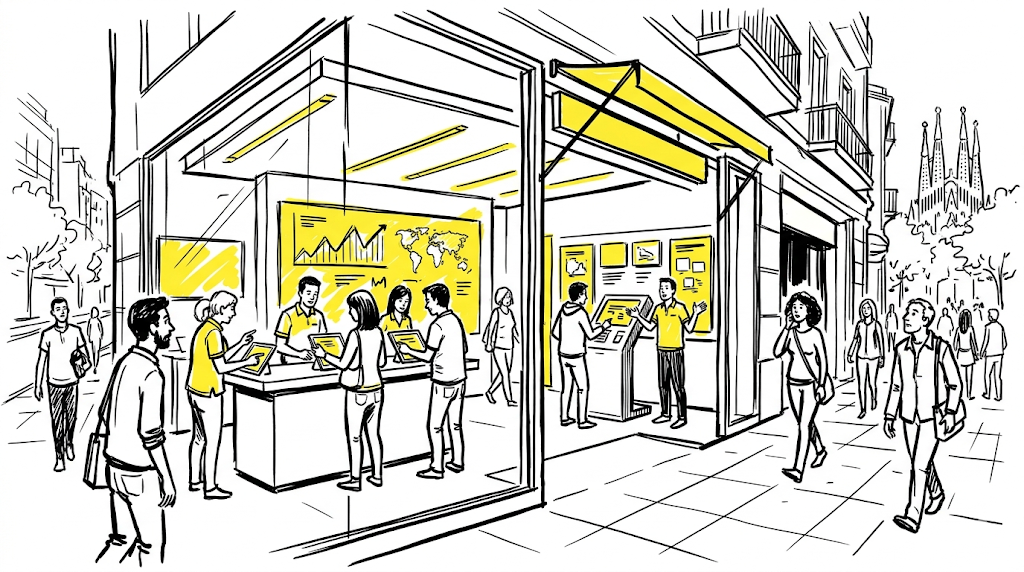

Revolut is opening its first physical store in Barcelona. For a company that scaled by being fully app-based, this is not a branding move. It reflects a shift in how growth behaves once fintech companies reach a certain scale.
At that stage, visibility is not the issue anymore. Revolut is already a recognised global brand. The constraint moves elsewhere. Digital acquisition still works, but it becomes less efficient. Users sign up, but a growing share does not fully convert into deeper engagement or long-term product use.
This is where many fintechs start to feel a slowdown that is not immediately visible in top-line metrics. The product is still strong. The funnel becomes weaker.
Why digital onboarding stops being enough
Early fintech growth assumes that a clean interface and strong features are enough to drive adoption. That works when users are actively searching for a better alternative.
As the market matures, behaviour changes. Users become more cautious. The decision to move financial activity into a new platform becomes less about functionality and more about trust and perceived risk.
That creates a gap between interest and commitment. It does not always show up as churn. It shows up as hesitation during onboarding, shallow product usage, and slower conversion into higher-value services.
That gap is difficult to close with digital touchpoints alone.
The store is a conversion layer, not a branch
The Barcelona store should not be interpreted as a return to traditional banking infrastructure. It does not replace the app and it is not meant to shift core usage offline.
Its role is more specific. It acts as a physical conversion point where users can reduce uncertainty. Some people need interaction before they commit fully. A store gives them that option without changing the product itself.
In that sense, it sits closer to distribution than to product experience. It supports decisions that are already in motion but not yet completed.
Why Barcelona is a controlled experiment
Barcelona is a deliberate choice because it concentrates multiple user types in one place. Local users, international residents, and transient visitors all interact with the city in different ways.
That makes it a useful environment to observe how physical presence affects behaviour across segments. It also allows Revolut to test whether a store influences conversion differently depending on user intent.
If the model works here, it becomes easier to replicate in other dense global cities where digital-first brands compete for attention in similar conditions.
Key takeaways
- Fintech growth eventually shifts from acquisition efficiency to trust and conversion efficiency.
- Digital channels do not fully solve hesitation at scale. Users often need additional signals before committing more deeply.
- Physical presence is not a replacement for digital products. It can act as a reinforcement layer when digital funnels start to weaken.
If you are building or scaling a fintech product and start seeing similar friction in conversion, onboarding, or trust, reach out. We can help.


