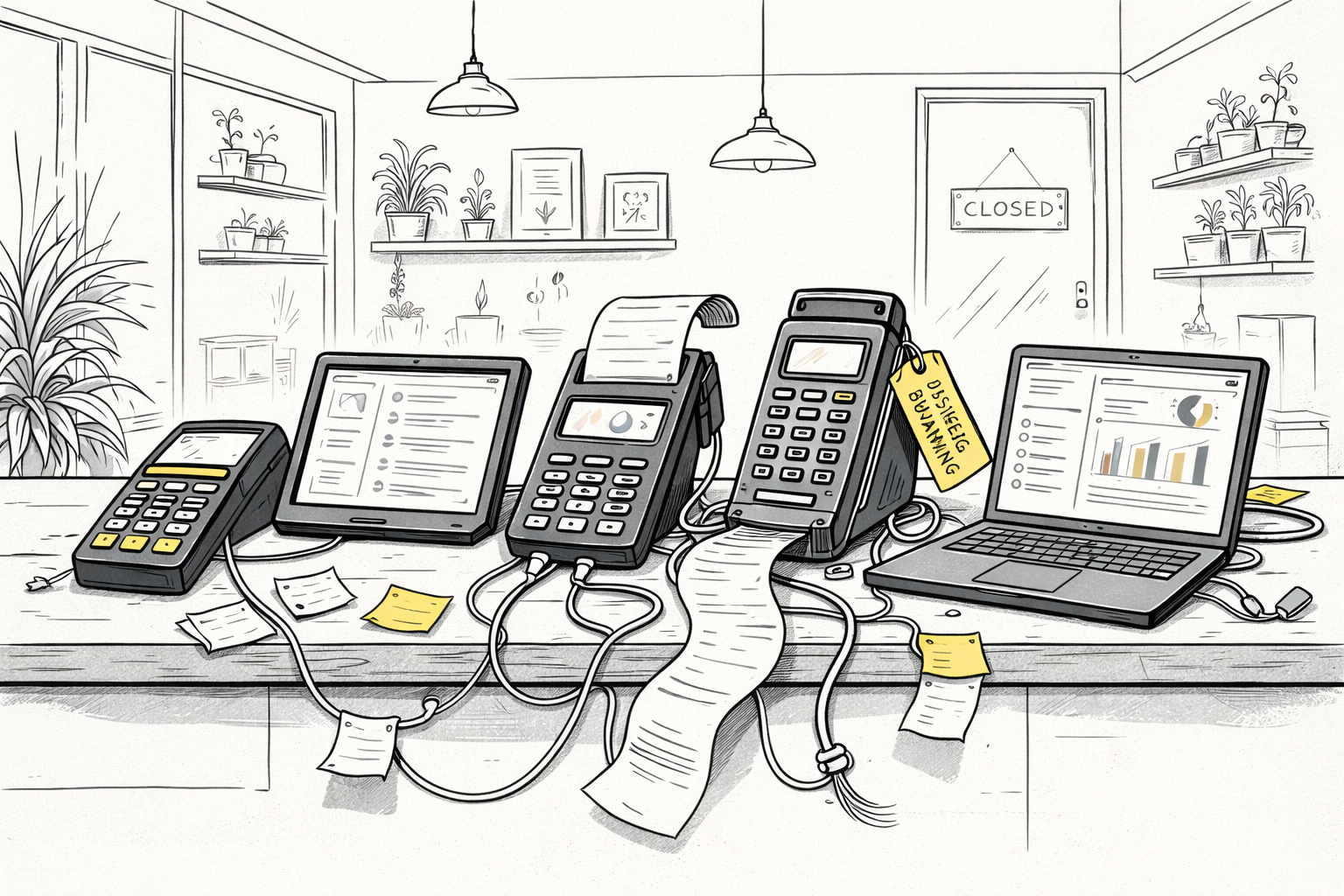
For a market as advanced as the UK, business banking still feels surprisingly fragmented. That’s the core idea behind Zeller’s expansion. Not a new feature. Not a better card reader. A more fundamental claim: small businesses are still stitching together too many financial tools, and no one has properly fixed it.
Zeller is stepping in with a familiar fintech promise, but with sharper positioning. One system instead of five. Timing matters here. The UK is a large, competitive market with millions of businesses and a huge volume of card payments flowing through it every year. On paper, it looks well served. In practice, Zeller is betting that the everyday experience of managing money is still far from smooth.
The real problem isn’t payments, it’s fragmentation
Zeller’s argument is simple, and hard to disagree with. Most small businesses don’t run on a single financial system. They juggle payments providers, bank accounts, cards, invoicing tools, and reporting platforms. Sometimes it adds up to a surprisingly complex stack for something as basic as getting paid and tracking money.
That creates friction everywhere. More logins, more fees, more reconciliation, and more time spent managing finances instead of running the business itself.
Traditional banks haven’t really solved this. If anything, they’ve reinforced it with disconnected products, slow processes, and pricing that is not always easy to understand.
Zeller’s pitch is to remove that complexity entirely by combining payments, accounts, cards, and financial tracking into a single system. It is not a new idea, but it is still rare to see it executed cleanly.
Built for cash flow, not just transactions
One detail Zeller leans into heavily is cash flow. This is where many financial tools quietly fail small businesses. Payments might be fast at the point of sale, but access to funds, visibility, and control often lag behind.
Zeller’s model focuses on shortening that gap. Payments settle into a connected business account, while spending, tracking, and reporting all sit in the same place. The idea is to reduce the delay between earning money and actually being able to use it.
That matters more than it sounds. Cash flow issues are one of the most common reasons small businesses struggle, yet much of the financial infrastructure still treats payments, banking, and expenses as separate problems. Zeller treats them as one continuous flow.
Why the UK, and why now
The UK is not an easy market to enter. It is one of the most mature fintech ecosystems, with strong incumbents and a wave of challenger banks already competing for attention.
But that is also what makes it attractive. Digital payments are now standard, and expectations around speed, transparency, and flexibility are higher than before. Businesses are no longer comparing fintechs to banks. They are comparing experiences across the board.
Zeller is not trying to introduce a new behavior here. It is aligning with an existing shift, where businesses expect their financial tools to work together seamlessly. Early traction suggests there is at least some appetite for that approach, even in a crowded space.
The bigger bet
Zeller is not just entering a new market. It is testing whether its all-in-one model can scale beyond its home base.
The thesis is straightforward. If small businesses face similar structural problems across markets, then a unified financial stack should travel well.
The risk is just as clear. In a crowded market, being simpler is helpful, but not always enough. You also need to be meaningfully better in the details that matter day to day.
Zeller seems to believe that reducing complexity, improving cash flow visibility, and offering more transparent pricing is that edge. The UK will be a useful test of whether that belief holds up under real competition.
Key takeaways
- Zeller is entering the UK with an “all-in-one” financial stack for small businesses
- The core problem it targets is fragmentation, not payments themselves
- Small businesses often rely on multiple disconnected financial tools
- Zeller’s approach is to unify payments, banking, cards, and reporting in one system
- Cash flow visibility and speed of access to funds are central to its value proposition
- The UK is a mature and competitive fintech market, making it a strong but challenging test case
- Success depends less on the idea and more on execution quality in a crowded space
If you’re building in fintech or SMB infrastructure and want to explore similar stories or collaborate, feel free to reach out.