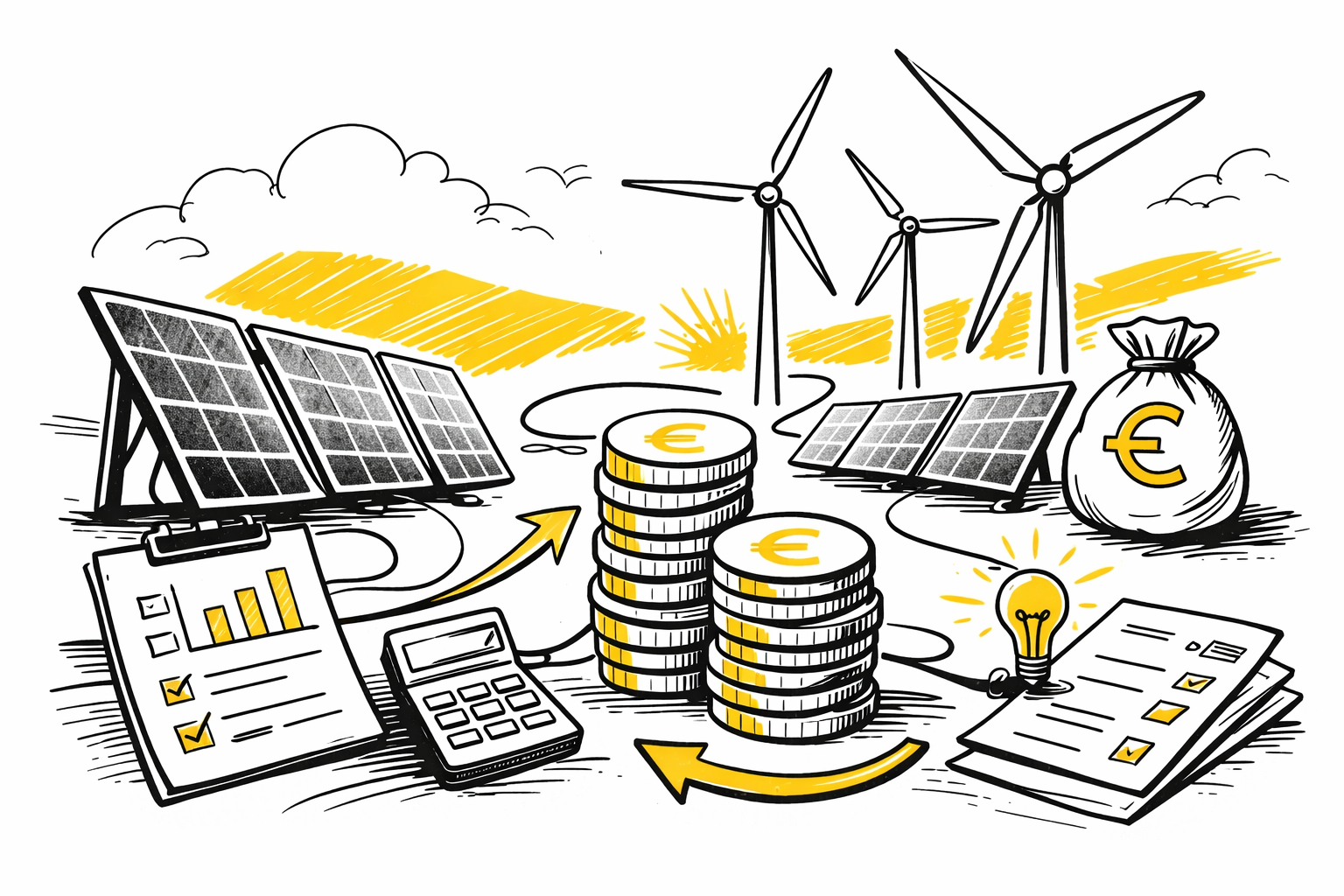
Berlin-based climate fintech Cloover has secured a €1.04 billion financing commitment, combining €18.8 million in Series A equity with a €1.02 billion debt facility. The structure is backed by a large European bank and supported by a €300 million guarantee from the European Investment Fund.
For a company founded in 2023, this is an unusually ambitious capital setup. It reflects both the scale of the energy transition challenge and the appetite among investors for platforms that can turn climate goals into operational reality.
Cloover was founded by Jodok Betschart, Peder Broms, and Valentin Gönczy with a focused mission: remove the financial friction that slows down residential and small-scale energy installations across Europe.
A Platform Built Around Real-World Constraints
Cloover’s product combines software and financial services into a single operating environment for installers, manufacturers, households, and institutional investors. Instead of treating financing as an external afterthought, the platform embeds it directly into the workflow of energy projects.
The company uses AI-assisted credit underwriting and automation to streamline approvals and reduce administrative overhead. For households, this means access to clean energy without large upfront payments. For installers, it removes one of the biggest sales blockers: uncertainty around how projects will be funded. Cloover also pre-finances public subsidies, allowing customers to benefit from incentives without waiting months for reimbursement.
This is not about adding another loan product. It is about reshaping how energy projects move from intent to execution.
Why the Capital Structure Matters
The financing commitment is split intentionally.
The debt facility is designed to fund customer and installer financing directly through the platform. It is the engine that turns demand into deployed infrastructure. The equity round provides growth capital for product development, hiring, and geographic expansion.
The European Investment Fund guarantee lowers the risk profile for lenders and helps reduce the cost of capital. In practical terms, it makes financing more affordable for end users and more scalable for Cloover.
This blended approach is increasingly common in climate fintech. Equity alone cannot fund asset-heavy transitions. Debt without strong technology and distribution struggles to reach fragmented markets. Cloover’s model sits in the middle.
Scaling Distributed Energy in Europe
Cloover is already active in Germany, Switzerland, Sweden, and the Netherlands, with plans to expand into France, Italy, the UK, and Austria. The company reported more than 8x revenue growth in 2025, approaching €85 million, and has outlined aggressive expansion plans through 2027.
From an investor perspective, this is a bet on infrastructure at the edges of the grid. Residential solar, heat pumps, batteries, and small commercial installations have historically been under-served by traditional finance. They are too small, too fragmented, and too operationally complex for standard lending models.
Platforms that can aggregate, standardise, and finance these assets unlock an entirely new class of investable infrastructure.
Key takeaways for fintech startups
Cloover’s announcement highlights several patterns worth paying attention to:
- Large-scale impact markets often require blended capital structures, not just venture equity.
- Embedding finance directly into operational workflows reduces friction and drives adoption.
- Institutional guarantees can materially change unit economics and unlock scale.
- Asset-heavy sectors reward platforms that combine technology, distribution, and capital access.
If you are building a fintech in a complex, regulated, or infrastructure-heavy market, these dynamics matter. At Your Fintech Story, we help founders shape strategies that resonate with both investors and real-world operators. If you are navigating similar challenges, we would love to help you sharpen your story and growth plan.