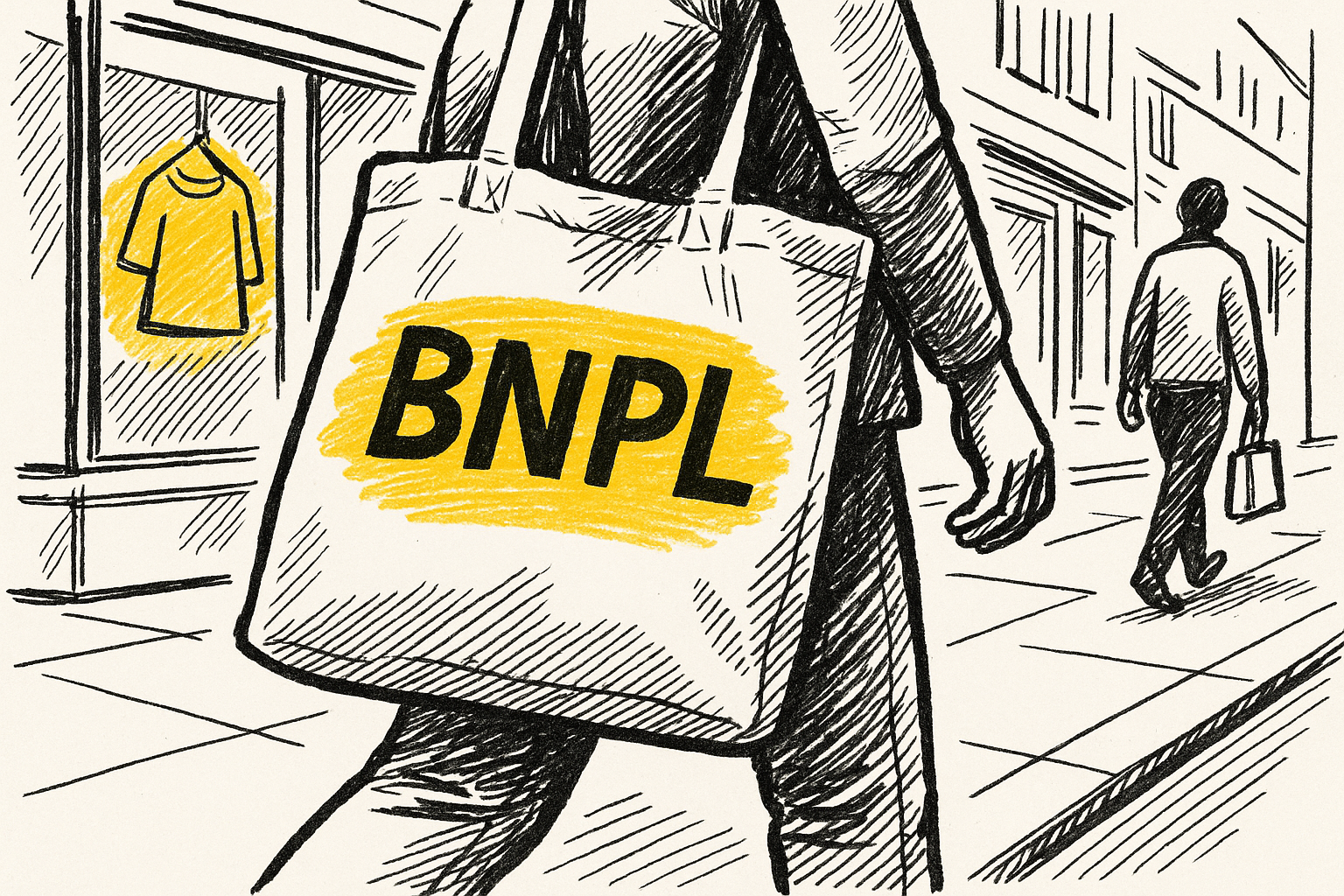
Buy Now, Pay Later (BNPL) has become one of the most transformative forces in digital payments. Earlier this year, The Future of Global Payments & Fourth Generation Payment Networks (June 2025) reported that BNPL transactions had grown 18% between 2022 and 2023, reaching 5% of global e-commerce spending — over $316 billion.
That momentum hasn’t slowed. BNPL has evolved from a niche checkout option into a standard expectation. For fintech founders, it’s no longer about whether to include BNPL — it’s about how to integrate it responsibly and profitably.
What makes BNPL so appealing
BNPL lets customers split a purchase into smaller payments while merchants still receive the full amount upfront. Consumers enjoy interest-free installments, and fintechs offering the service gain loyalty and engagement.
It works because it removes friction. Shoppers get flexibility without using a credit card, and merchants see higher conversion rates and larger order sizes. The report notes that merchants typically pay 2–8% per transaction, but the extra sales often make it worthwhile.
For younger consumers, it’s a matter of trust and control. BNPL is transparent, mobile-first, and debt-averse by design. In surveys cited by the report, 31% of Gen Z shoppers said they’d switch to merchants offering BNPL, showing just how powerful this feature can be for acquisition.
Who is using BNPL
The typical BNPL customer is a young adult in a high-income economy, often a woman aged 18–35 earning $50–100k per year and spending about $688 annually through BNPL. That profile shows this isn’t a product for the financially distressed — it’s for people managing budgets more actively.
Adoption differs by region. Northern Europe leads: Sweden sees about 25% of e-commerce via BNPL, Germany about 20%, and Australia around 10%. The U.S. continues to grow quickly, driven by younger shoppers. In Asia-Pacific, where many adults remain unbanked, BNPL is expanding at roughly 16% annually through 2027. Latin America still sits below 1% of e-commerce spend but is projected to triple its BNPL value by 2029.

The challenges fintechs should note
Rapid growth has drawn regulatory attention. Because BNPL often skips formal credit checks, consumers can stack multiple plans and end up with hidden debt. The report cautions that tighter regulation could significantly reshape the sector once governments classify BNPL as a form of credit.
For fintech startups, the lesson is to stay ahead of compliance. Responsible design — clear disclosures, fair fees, and education — builds resilience before new rules arrive. It also protects brand reputation in a space increasingly scrutinized for transparency.
Where BNPL is heading
BNPL is moving beyond retail into travel, healthcare, and everyday services. The report shows that retail goods accounted for 50.5% of BNPL purchases in 2021, down from 57% in 2020, as users increasingly applied installment payments to experiences, medical costs, and entertainment.
This shift suggests that BNPL is becoming a general-purpose financing tool rather than just a retail feature. It’s turning into a flexible payment layer embedded across daily life — a pattern fintechs can build on through sector-specific partnerships or niche offerings.
In markets such as Southeast Asia, where up to 76% of adults remain unbanked, BNPL could also serve as a bridge to financial inclusion, letting people access digital commerce without traditional credit lines.
The report projects global BNPL transaction value to reach $454 billion by 2027, underscoring that the model is still in its growth phase. For fintech founders, the opportunity lies in applying BNPL responsibly — whether as a core product, a feature, or a partnership.
Key takeaways for fintech startups
- BNPL is mainstream. It already powers roughly 5% of global e-commerce.
- It drives conversion. Splitting payments lifts both purchase completion and basket size.
- Consumer demand is generational. Younger users prefer it to credit cards.
- Regulation is coming. Build transparency and compliance early.
- Adoption is regional. Tailor BNPL strategies to market maturity and trust levels.
- Education builds loyalty. Clarity prevents debt traps and enhances credibility.
- Use cases are diversifying. BNPL now covers travel, health, and services, not just shopping.
Final thought
BNPL is a blueprint for how consumers expect to pay in 2025 and beyond. As the Future of Global Payments & Fourth Generation Payment Networks report highlights, it’s redefining access to credit while promoting inclusion on a global scale.
If you’re a fintech founder exploring how BNPL or new payment models can support your growth, Your Fintech Story can help. We work with startups to refine strategy, identify opportunities, and scale responsibly.
Let’s build your fintech story and make it sustainable.