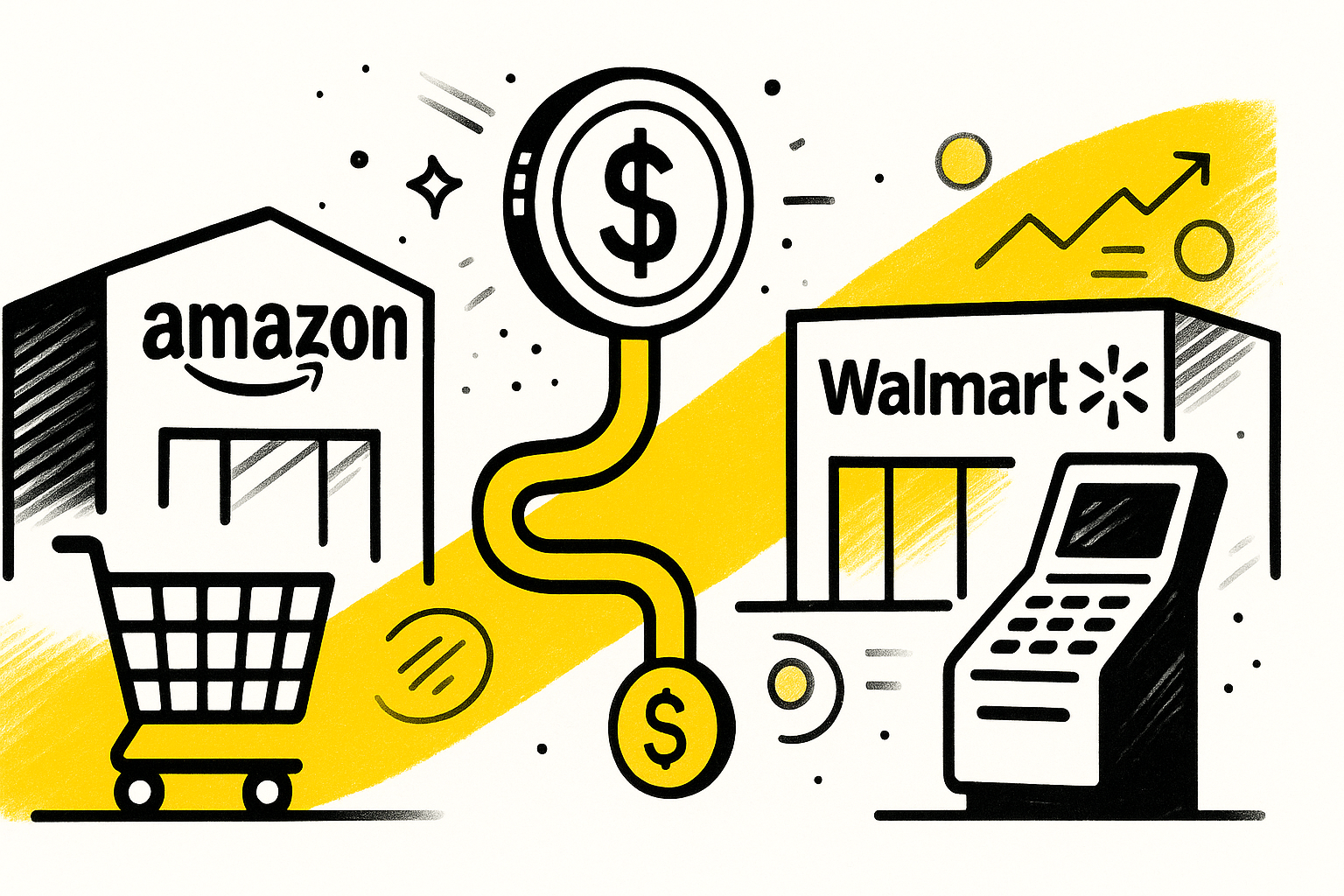
They’re not printing money (yet). But they’re inching toward a future where they might not need banks — or even Visa.
Multiple reports now suggest that Amazon and Walmart are exploring the idea of issuing their own USD-pegged stablecoins. No flashy coin names. No launch dates. But internal discussions are happening, and the companies are watching one bill in particular: the GENIUS Act, which could give legal clarity to corporate-issued stablecoins in the U.S.
So far, no one’s confirmed anything publicly. But when the two biggest retailers in the country even consider issuing their own currency, it’s worth pausing to ask why.
It’s not about crypto. It’s about control.
For Amazon and Walmart, the appeal isn’t decentralization or tokenomics — it’s efficiency. Every year, they pay billions in interchange fees to the card networks. Every refund, every transaction delay, every piece of customer data handed to someone else? It adds up.
If they can roll their own stablecoin — or co-own one with a consortium of merchants — they could:
- eliminate card fees
- settle transactions instantly
- build loyalty mechanics directly into the payment method
- and fully own the checkout experience
It’s like inventing store credit, but smarter, more scalable, and regulation-ready.
And that last part matters. The GENIUS Act, which could pass this year, would finally create a regulatory lane for corporate stablecoins. Until then, no one’s moving fast. But the prep work is clearly underway.
There’s still a long way between exploration and execution.
At this point, there’s no rollout timeline, no UX mockups, and no sign of whether they’ll build or partner. There’s speculation that these stablecoins could be tied to rewards or perks — think 2% off if you use “Amazon Dollars” — but that’s still just theory.
And even if they do launch, adoption won’t be automatic. Customers already trust cards, and PayPal’s own stablecoin hasn’t exactly taken off. Changing behavior at scale takes more than infrastructure — it takes a reason.
That said, Amazon and Walmart are two of the only companies that might actually pull it off. They have daily transaction volume, brand trust, and ecosystem lock-in. If anyone can get tens of millions of people using branded money, it’s them.
For fintech founders, this isn’t background noise.
This could signal a real shift in how payments work — and who owns the rails. Not overnight, but fast enough that anyone building in fintech needs to pay attention.
If you’re working on anything in wallets, custody, loyalty, compliance, or cross-border payments, there may be room to plug in. Whether that’s supporting a new stablecoin issuer, integrating with one, or even launching something of your own under the same legal umbrella — this moment is bigger than just Amazon and Walmart.
Key takeaways for fintech startups
- Don’t focus on the coin. Focus on what it replaces: card fees, laggy refunds, middlemen.
- The GENIUS Act is the true trigger — once it passes, stablecoins may become infrastructure, not just experiments.
- Adoption depends on incentives. That’s an opening for smart product and loyalty design.
- Infrastructure will need to be battle-tested. If the giants move, their partners will need to scale fast.
This isn’t about crypto getting mainstream. It’s about payments becoming verticalized. If your product sits anywhere near where money moves — this is your head start.
At Your Fintech Story, we help fintech startups get sharper on strategy and go-to-market. Let’s talk.