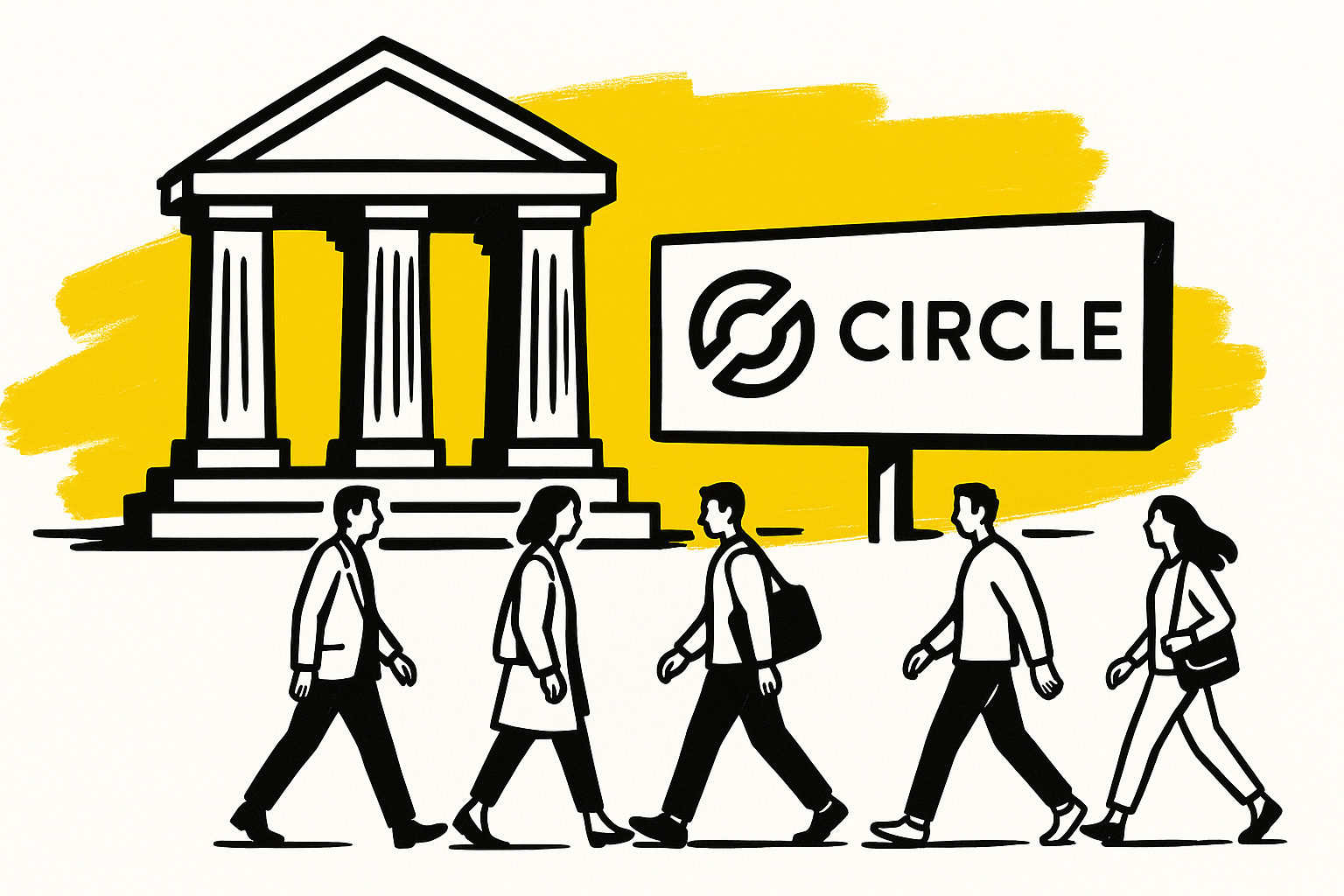
In a June 4 press release, Circle Internet Group, Inc. (the fintech behind USDC stablecoin) announced the upsizing of its IPO to 34 million shares at $31 each, raising around $1.05 billion and valuing the company at $7.2 billion. Shares began trading on the NYSE under the ticker CRCL on June 5, 2025. This is the first public listing of a pure-play stablecoin issuer, highlighting strong market appetite for crypto-fintech.
Circle had previously tried to go public via a SPAC deal in 2021, but that fell through. Now, with oversubscription and rising investor demand, the offering grew. Reports suggest ARK Invest may take a $150 million stake, with BlackRock eyeing 10% of the float.
As CEO Jeremy Allaire put it, becoming a public company is a “significant and powerful milestone” on the path to building a modern, internet-based financial system.
A Major Milestone in Circle’s Journey
Circle’s defining moment came in May 2022, when the collapse of TerraUSD (UST) rattled the crypto industry. As confidence in algorithmic stablecoins crumbled, users turned to safer options; and USDC, with its fully-backed, transparent model, was ready. Its circulation rose from $48 billion to $54 billion, gaining a bigger share of the market. That flight to quality solidified Circle’s position as a trusted leader.
By 2025, USDC holds around $60 billion in circulation, and Circle’s cautious approach is paying off. Its model; earning interest on reserves while staying compliant, generated $557.9 million in Q1 2025 alone. Once niche, USDC is now a core part of the stablecoin economy, and its reliability laid the foundation for Circle’s strong IPO.
Meanwhile, regulation is moving in Circle’s direction. The GENIUS Act, a bipartisan stablecoin bill, proposes clear rules around full dollar backing and anti-money laundering. For Circle, this isn’t a challenge, it’s a confirmation. The company has long operated under similar standards.
“Tonight’s vote on GENIUS Act is a huge step forward in advancing dollar digital currency as the foundational layer of the Internet financial system.”
— Jeremy Allaire, CEO of Circle Internet Financial
If passed, the law could boost adoption by giving banks and fintechs clearer guidance; and Circle, already built for compliance, is ready to lead.
Key takeaways for fintech startups
Here are a few lessons fintech founders can take from Circle’s IPO journey:
Compliance builds trust: Circle’s transparency and regulatory alignment helped win over big investors. Clear rules can unlock serious growth.
Stay the course: Circle’s failed 2021 SPAC wasn’t the end. Timing matters; persistence and focus paid off later.
Solve real problems: USDC met a clear need for stable, fast payments. Strong product-market fit beats hype.
Leverage partnerships: Trusted names like BlackRock and top underwriters gave Circle added credibility.
Profitability wins: Interest on reserves turned into real revenue. A clear, sustainable business model matters.
Enjoyed this story? Let’s keep the conversation going. Connect with us to share your journey, gain insights, and shape your next chapter in fintech.
Pricing can make or break a fintech startup. Charge too much or too little, and you might scare off customers or bleed cash. Get it just right, and you can turbocharge growth and even reshape an industry. In this article, we’ll explore real stories of fintech ventures (2019–2025) that mispriced their offerings and paid the price, as well as those that nailed their pricing strategy to great success. Early-stage fintech founders (whether B2B or B2C) will find plenty of cautionary tales and inspiration for setting the right price on innovation.
5 Fintechs That Got Burned By Bad Pricing
Even well-funded startups can stumble when their pricing strategy backfires. Here are five fintech companies that suffered shutdowns, pivots, or collapses due to pricing missteps:
Xinja: Lured Customers With Unsustainable Interest Rates
Australia’s Xinja bank offered a sky-high 2.25% interest on its “Stash” savings accounts to lure customers, far above market rates. The promo worked too well: a flood of deposits poured in, and Xinja had to stop taking new customers within two months. Unfortunately, that generous rate was unsustainable; it quickly burned through Xinja’s capital. As the central bank slashed rates, Xinja repeatedly cut its interest payout, but the damage was done. By late 2020, Xinja shut down its banking operations, returning deposits and surrendering its license amid mounting losses.
The lesson? Don’t offer promos or yields so rich that they threaten your bank’s survival.
Beam: Overpromised Yields, Underdelivered Value
U.S.-based Beam Financial dangled “200× higher” interest rates than banks to attract savers. The catch: those eye-popping yields were largely illusory. Many users got a meager 0.04% instead of the promised 0.2–1%, and worse, countless customers couldn’t withdraw their money on demand. Beam’s pricing gimmick: effectively a too-good-to-be-true savings rate, led to a flood of complaints and intervention by the U.S. Federal Trade Commission.
In late 2020, the FTC sued Beam for misleading customers and freezing funds. Beam’s reputation was shattered. Overpromising and underdelivering on pricing not only alienated users but also invited regulators to shut the party down.
Fast: Gave It All Away for Free, Then Ran Out of Cash
Fintech startup Fast tried to conquer online payments by making its checkout free and frictionless for merchants and shoppers.
The problem? Fast had no viable revenue model to cover its sky-high expenses. By 2021, the company was burning roughly $10 million every month on marketing and overhead while generating only about $600,000 in annual revenue. In other words, Fast subsidized users heavily (offering its service for “free”) without figuring out how to get paid sustainably.
The result was inevitable: after raising $120M in funding, Fast ran out of cash and abruptly shut down in April 2022, laying off 450 employees. This is a stark warning that “free” isn’t a winning price if you can’t convert it into profits.
Wonga: Charged Too Much, Then Faced the Fallout
UK-based Wonga built a booming business in the 2010s lending small sums online with sky-high fees and interest. Initially, the steep pricing (often over 1,000% APR on short-term loans) drove rapid profits. But that predatory model eventually imploded. Wonga’s exorbitant charges sparked public outrage and a regulatory crackdown; Britain’s Financial Conduct Authority imposed an interest rate cap in 2015.
Soon, Wonga was overwhelmed by compensation claims from misled and overcharged customers. By 2018, facing huge losses and reputational damage, Wonga collapsed into administration.
The takeaway: exploitative pricing can earn you a one-way ticket to bankruptcy. In fintech, ethics and sustainability matter – price your services in a way that delivers value without preying on customers.
Synapse: Got Cut Out of the Value Chain
Synapse offered fintech startups plug-and-play banking features at low cost, acting as a middleman between small fintechs and regulated banks. Its BaaS pricing attracted many clients; until a key partner decided to cut Synapse out. In 2022, Synapse’s own bank partner and a large client (Mercury) realized they could work directly with each other and eliminate Synapse’s fees. This disintermediation gutted Synapse’s business.
By 2023, Synapse was struggling with layoffs and ultimately filed for Chapter 11 bankruptcy protection. The mistake? Not providing enough unique value to justify its pricing. If your clients can bypass you to save money, they probably will.
5 Fintechs That Nailed Their Pricing Game
These five fintech companies – spanning B2C and B2B – found pricing strategies that not only won customers, but also built sustainable, high-growth businesses:
Wise: Won by Charging Fair, Transparent Fees
This London-based remittance fintech built its brand on transparent, fair fees for international transfers. Instead of hidden markups, Wise charged a straightforward low percentage and showed customers the real exchange rate.
That honesty earned user trust and massive volume. By focusing on fair pricing (often 8× cheaper than banks), Wise created value for customers and shareholders. The company grew profitably, handled tens of billions in volume annually, and went public in 2021 at an £8 billion valuation. Transparency was a winning price strategy, turning Wise into a global fintech leader.
Robinhood: Disrupted an Industry with $0 Trades
Robinhood turned the brokerage industry on its head by eliminating trading commissions for retail investors. While traditional brokers charged $5–10 per trade, Robinhood’s app let users trade stocks for $0, attracting droves of young investors.
The company monetized indirectly (through payment for order flow and premium subscriptions), while users enjoyed free trades. Robinhood’s model was so successful that it forced the entire U.S. brokerage industry to follow suit in 2019. This is a prime example of creative pricing: Robinhood made trading free for users and built a multi-billion-dollar business by finding revenue elsewhere.
Afterpay: Aligned Pricing with Merchant Value
Australian fintech Afterpay mastered the art of win-win pricing in consumer credit. Its insight was to charge retailers instead of consumers: shoppers pay no interest to split a purchase into installments, while the merchant pays Afterpay around a 4% “take rate” on the sale. This model aligned perfectly with customer desires and merchants’ goals.
In just a few years, Afterpay grew so large that in 2021 Square acquired it for $29 billion. By making the end-user deal attractive and charging the other side of the platform, Afterpay nailed pricing.
Stripe: Scaled Through Simple, Developer-Friendly Fees
Stripe won over startups and developers by offering simple, pay-as-you-go pricing for online payments. Any business could integrate Stripe’s API and pay a flat 2.9% + 30¢ per transaction – no setup fees, no monthly minimums. That simplicity and transparency were huge selling points in a complex payments industry.
Stripe’s straightforward pricing lowered the barrier for small businesses and became the default payment solution for startups. This usage-based model scaled as their clients grew.
By 2021, Stripe was valued at $95 billion. Convenience and clarity in pricing beat out cheaper but confusing rivals.
Nubank: Grew by Removing Traditional Banking Fees
Brazil’s Nubank became the world’s largest neobank by eliminating the nuisance fees that legacy banks charged. It launched a credit card with no annual fee, at a time when Brazilian incumbents profited from hefty yearly fees. Nubank’s free account and card, managed via a sleek app, drew tens of millions of customers.
By 2021 Nubank had over 40 million clients and turned its first profit. Its IPO valued it around $45 billion. Nubank showed that removing fees in a fee-fatigued market can catapult your growth. The bank makes money through interchange fees, lending, and optional services.
Actionable Takeaways for Fintech Founders
For early-stage fintech founders, these examples underscore that pricing is a strategic lever, not just a number. Here are some practical lessons to consider:
Validate Unit Economics Early: Don’t assume a free or underpriced service will figure itself out later. If you lose money on each user, even viral growth can kill you.
Avoid Race-to-the-Bottom Pricing: Deep discounts or flashy interest rates can be deadly without a plan for sustainability. Balance growth incentives with long-term health.
Price to Value, Not Exploitation: If your monetization relies on gouging or hiding fees, expect backlash and regulator attention. Fair pricing builds trust.
Test and Iterate Carefully: Pricing is not one-size-fits-all. Test pricing tiers and changes in small experiments and talk to your users.
Justify Your Place in the Value Chain: Especially in B2B fintech, clients must feel you offer irreplaceable value. If they can go direct, they often will.
Ready to Tell Your Story?
Is your fintech grappling with pricing challenges or looking to highlight its unique value to the market? Your Fintech Story is here to help. We specialize in crafting compelling narratives and strategic insights for fintech founders. Contact us to discover how we can help you refine your pricing strategy, avoid costly mistakes, and share your success story with the world.
Manage Consent
To provide the best experiences, we use technologies like cookies to store and/or access device information. Consenting to these technologies will allow us to process data such as browsing behavior or unique IDs on this site. Not consenting or withdrawing consent, may adversely affect certain features and functions.
Functional
Always active
The technical storage or access is strictly necessary for the legitimate purpose of enabling the use of a specific service explicitly requested by the subscriber or user, or for the sole purpose of carrying out the transmission of a communication over an electronic communications network.
Preferences
The technical storage or access is necessary for the legitimate purpose of storing preferences that are not requested by the subscriber or user.
Statistics
The technical storage or access that is used exclusively for statistical purposes.The technical storage or access that is used exclusively for anonymous statistical purposes. Without a subpoena, voluntary compliance on the part of your Internet Service Provider, or additional records from a third party, information stored or retrieved for this purpose alone cannot usually be used to identify you.
Marketing
The technical storage or access is required to create user profiles to send advertising, or to track the user on a website or across several websites for similar marketing purposes.