Day: May 21, 2025

  • U.S. Stablecoin Bill Advances: What Fintech Founders Need to Know

    U.S. Stablecoin Bill Advances: What Fintech Founders Need to Know

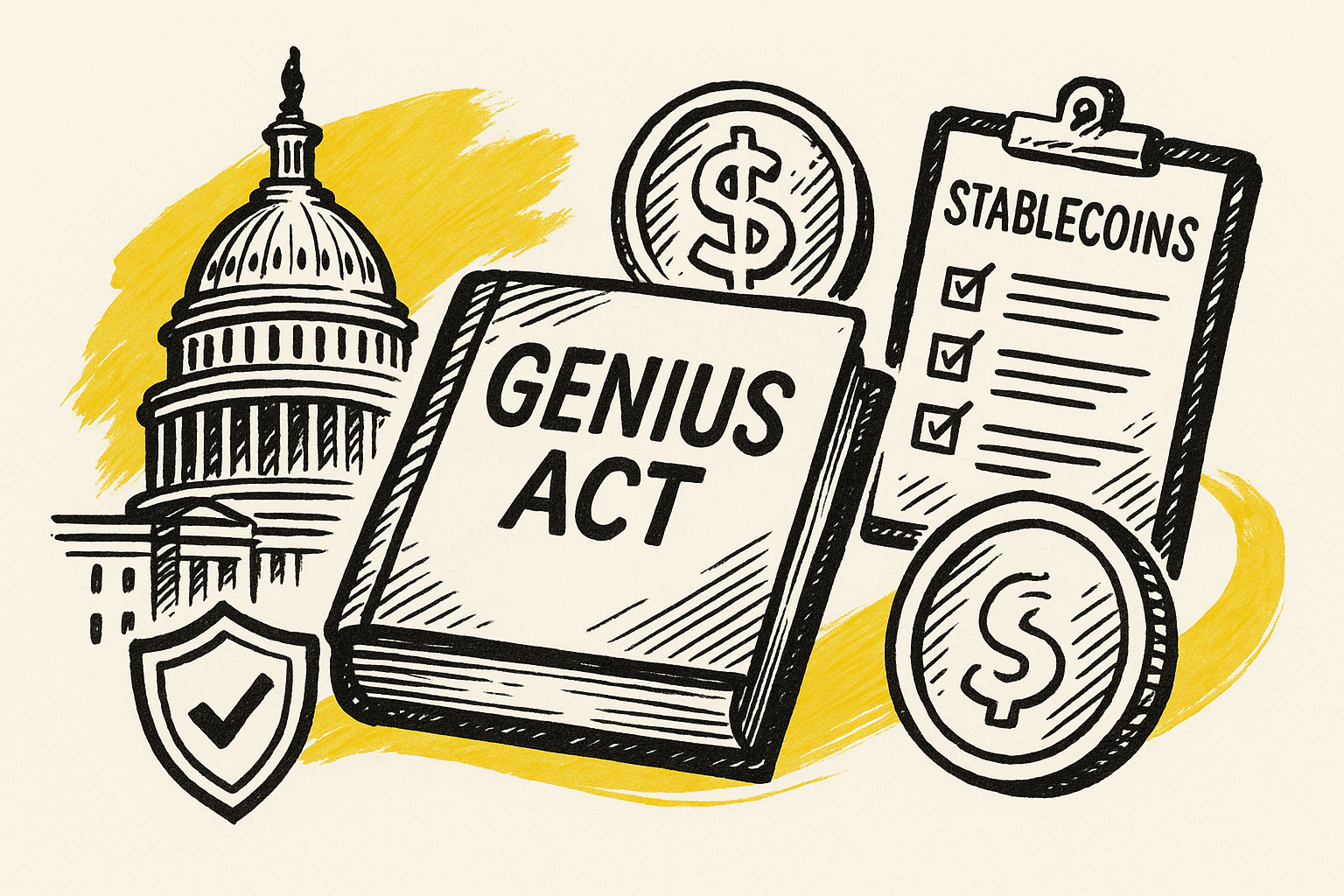
    The United States is making a move toward serious digital asset rules with the GENIUS Act (Guiding and Establishing National Innovation for U.S. Stablecoins). While the acronym leans ambitious, the bill itself is focused on creating the first federal framework for stablecoins backed by U.S. dollars and used for payments.

    With stablecoins showing up in everything from fintech apps to international transfers, the regulatory fog has started to worry lawmakers. The GENIUS Act steps in with actual structure: clear requirements for reserve backing, transparency, and licensing. In other words, it’s a shot at turning stablecoins into something the traditional financial system might actually invite to the table.


    Key takeaways for fintech startups

    Here’s what fintech startups should keep in mind as the GENIUS Act moves forward:

    • The Act lays out the first comprehensive federal rules for U.S. payment stablecoins; bringing long-needed clarity to the space.

    • That clarity can help fintechs build smarter partnerships and stay ahead on compliance.

    • Startups looking to issue or work with stablecoins should be ready for tighter standards around reserves, audits, and KYC.

    • The political attention on some issuers is a reminder: strong governance and transparency aren’t optional. They’re strategic.

    • Keeping an eye on how the bill evolves will be key for staying aligned and competitive as the regulatory landscape takes shape.


    If the GENIUS Act goes through, it could unlock some real doors for fintechs. With stablecoins finally getting a regulatory stamp of approval, startups could build with more confidence; think smoother cross-border payments, B2B use cases that don’t involve five intermediaries, and digital wallets that don’t feel like side projects. It could also make conversations with banks and institutional partners a lot less awkward. In short: regulation might finally give fintechs the green light to get serious (and creative) with dollar-backed digital money.


    Momentum in the Senate

    The Senate advanced the GENIUS Act with a 66–32 procedural vote, clearing a key hurdle and setting the stage for full debate. The bipartisan support signals growing alignment around the need for clearer rules in the fast-moving stablecoin space.

    “The GENIUS Act has been a long time coming, and my goal in this process was to ensure that we have a clear regulatory framework for stablecoins that promotes innovation while protecting consumers.”

    – Senator Cynthia Lummis


    As the bill moves into full debate, both policymakers and industry leaders are paying close attention to how the final wording could shape the direction of digital payments—and the role stablecoins will play within it.


    Key Provisions of the GENIUS Act

    The GENIUS Act outlines a clear set of regulatory standards for U.S. payment stablecoins:

    • Federal registration – Issuers will need to register with a designated federal agency.

    • 1:1 reserve backing – Stablecoins must be backed by cash or U.S. Treasury securities at all times.

    • Transparency and audits – Monthly disclosures and independent audits will be required to ensure accountability.

    • Redemption rights – Consumers must be able to redeem stablecoins at face value, on demand.

    • AML and KYC compliance – Issuers and intermediaries must meet standard anti-money laundering and customer verification requirements.

    • Restricted issuance – Only authorized entities will be permitted to issue payment stablecoins within the U.S.

    Together, these measures are designed to support a more secure, transparent, and reliable environment for stablecoin use within the broader financial system.


    Implications for the Crypto Industry

    If approved by the Senate, the GENIUS Act will move to the House of Representatives for further consideration. While other proposals – like the STABLE Act and FIT21 – are also in play, the GENIUS Act currently offers the most detailed blueprint for stablecoin oversight.

    The bill has drawn cautious support from parts of the fintech and crypto sectors, though major issuers such as Circle (USDC) and Tether (USDT) have yet to formally endorse it.

    If your fintech startup is exploring stablecoin-based solutions, now is the time to align with federal regulatory developments. Contact us to build a strategy that supports growth and compliance in a changing landscape.

  • Google’s AI Checkout Shows What Frictionless Really Means

    Google’s AI Checkout Shows What Frictionless Really Means

    At Google I/O 2025, the company announced a major upgrade to online shopping: a new AI-driven feature called agentic checkout, part of its broader AI Mode experience. This marks a shift from search-and-click to AI-assisted shopping, where discovery, decision-making, and even purchasing are increasingly supported by automation; but with the user firmly in control.


    Checkout, On Your Terms

    Agentic checkout allows users to track a product’s price and set preferences such as size, color, and budget. When the price drops within your set range, Google notifies you. If you confirm, tapping “buy for me” triggers Google to add the item to the merchant’s cart and complete the checkout using Google Pay.

    The purchase is made on your behalf, but only after explicit confirmation. You define the parameters, and the AI handles the execution. According to Google, this system is designed to act “when the price is right for you,” offering a balance between automation and agency.

    “Our new AI Mode experience is built for every part of shopping; from finding inspiration to buying at the right moment.

    — Lilian Rincon, Vice President, Product Management, Google


    While still rolling out across U.S. listings, agentic checkout reflects a broader trend: removing friction from e-commerce by letting AI act as a digital assistant that monitors prices and completes purchases when all conditions are met.


    Discovery Reimagined with AI Mode

    Agentic checkout is only one part of Google’s new AI Mode, which redefines how users search for and narrow down products. Powered by Gemini and Google’s 50-billion-item Shopping Graph (refreshed over 2 billion times per hour), AI Mode turns general shopping queries into visually rich, dynamic result panels.

    For example, ask for a “blue backpack,” and AI Mode responds with personalized product images and listings. Add specifics, like a ‘trip to rainy Scotland,’ and it launches a query fan-out, running parallel searches to determine what features (e.g., waterproofing, portability) matter most. The results update in real time, surfacing highly relevant options from trusted retailers.

    This capability is designed to streamline how people shop by reducing guesswork, enabling real-time refinement, and surfacing products that align with nuanced intent.


    Smarter Everyday AI, Beyond Shopping

    Google’s announcements at I/O 2025 extended well beyond retail. Across its ecosystem, the company introduced AI-powered features designed to simplify daily tasks and decision-making. In Gmail, users will see AI-organized summaries and smart follow-up suggestions. Google Docs adds context-aware writing assistance, offering quick answers and document insights without switching tabs. On Android, a more conversational call screening assistant now engages callers using natural language. In Search, Gemini now supports multi-step reasoning, enabling more complex queries to be answered in a single exchange. And for e-commerce, Google’s new virtual try-on lets users upload a full-body photo to see how clothes from billions of listings would look on them, bringing personalization to a new level in online shopping.

    These features share a common thread: AI that works quietly in the background to reduce friction. Whether you’re searching, writing, scheduling, or deciding; Google is positioning AI as a proactive co-pilot, not a tool you have to ask for help.


    How Users Were Already Using Google Gemini

    Based on a March 2025 Morgan Stanley survey, this data reflects how users were already engaging with Gemini — primarily for product research, price comparison, and shopping — before Google’s latest AI shopping features were announced.


    Limited U.S. Rollout

    These features; agentic checkout, AI Mode discovery, and virtual try-on are rolling out gradually in the U.S. Google has not announced international availability. Agentic checkout will be introduced over the coming months across product listings. AI Mode’s query fan-out and dynamic visuals will follow a similar timeline. The try-on tool is live now in Search Labs for eligible users.

    While still in early stages, these tools suggest a future where AI removes complexity from shopping without compromising control, streamlining the decision journey from inspiration to checkout.


    Key takeaways for fintech startups:

    These updates reflect broader shifts in AI design that fintech leaders should watch closely.

    • Agentic checkout reflects a new model of user-controlled automation: AI completes purchases only after conditions are met and approval is given.

    • Query fan-out shows how simultaneous AI reasoning can surface more relevant results, with potential applications beyond retail.

    • Google’s approach preserves trust by anchoring automation in explicit user action; an important principle for fintech UX.

    • These tools emphasize scalability + personalization, with clear lessons for product teams building AI-assisted workflows.

    Want to design smarter digital fintech with clear value and no friction? Your Fintech Story helps fintechs build strategy that scales. Reach out to get started.